How to Change Your Registered Agent in Ohio (2026)

Changing your Ohio statutory agent costs $25 and requires the Statutory Agent Update form, known as Form 521, filed with the Ohio Secretary of State. You can file it online through Ohio Business Central, by mail, or in person. Regular processing takes about 3 to 7 business days.
Ohio law uses the term "statutory agent" instead of registered agent, though the two mean the same thing. Every LLC doing business in the state must continuously maintain one.
This guide walks through each filing method, who qualifies to serve as your new agent, and what happens if you miss the requirement.
Quick Summary
- Form 521 is the only paperwork the state accepts for a statutory agent change.
- You can file online, by mail, in person, or through a professional service provider.
- Ohio LLCs never file a periodic report, so keeping this filing current matters more here than in most states.
How to Change Your Ohio Registered Agent
To change your Ohio statutory agent, you fill out and submit the Statutory Agent Update form (Form 521). Send it to the Ohio Secretary of State's Business Services Division. The fee is set by Ohio Revised Code § 111.16(R)(1) [1], and the Quick Facts table below has the exact amount and timing for every filing channel.
| Item | Detail |
|---|---|
| Form | Statutory Agent Update (Form 521) |
| Filing fee | $25 |
| Filing agency | Ohio Secretary of State, Business Services Division |
| Online portal | Ohio Business Central |
| Regular processing | About 3-7 business days |
| Expedite tier 1 | $100, 2 business days |
| Expedite tier 2 | $200, 1 business day (walk-in) |
| Expedite tier 3 | $300, 4 hours (walk-in, by 1:00 p.m.) |
| Mail address (regular) | P.O. Box 788, Columbus, OH 43216 |
| Mail address (expedite) | P.O. Box 1390, Columbus, OH 43216 |
| Annual/biennial report | None required for LLCs |
You can complete this filing online, by mail, or in person, or you can hire a professional service to handle it for you. Here is how each filing method works.
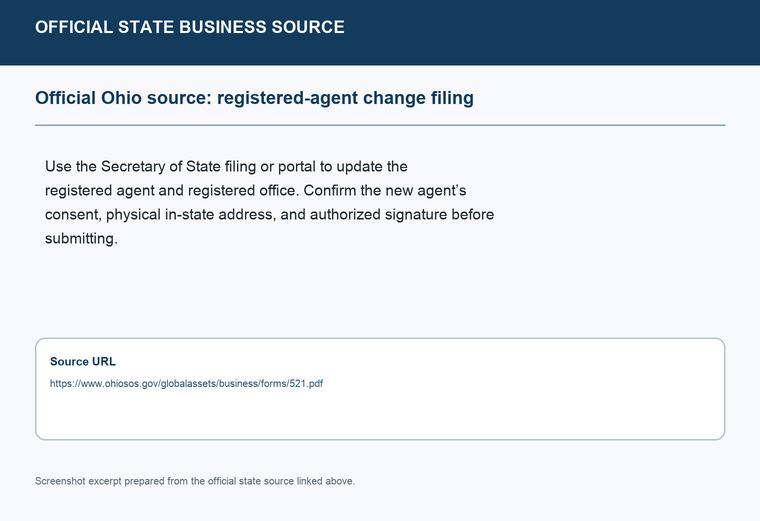
1. Changing Your Registered Agent Using a Professional Service
If you would rather not handle the paperwork yourself, hiring a professional service to change your Ohio statutory agent is a solid option.
- Pick a provider. A reputable service files the Statutory Agent Update form with the Ohio Secretary of State on your behalf.
- Send your details. You give the provider your entity name, current agent information, and new agent details, and they prepare and submit the form.
- Pay the fees. You cover the state's filing fee plus the provider's service charge, then wait for confirmation once the update is approved.
Compare providers on our list of Ohio registered agent services before you sign up. The national registered agent service roundup covers even more options if you want a broader look.
2. Changing Your Registered Agent Online
Filing online through Ohio Business Central skips the mailbox entirely. Processing runs on the same regular timeline as a mailed filing, but you submit and pay from your browser.
- Create a profile. Set up an account on the portal with your name, email, and contact details.
- Complete the form. Log in, open the Statutory Agent Update filing, and enter your business details along with the new agent's name and address.
- Pay and submit. Pay the filing fee by credit card or e-check, then submit the form for review. Your new agent still signs a separate Acceptance of Appointment, and the state will not record the change without it.
3. Changing Your Registered Agent by Mail or In Person
You can also change your statutory agent by mail or in person. Pick this route if you would rather send a check than pay online.
- Get the form. Download the Statutory Agent Update form and fill in your entity name, charter or registration number, and both agents' names and addresses.
- Sign it correctly. An LLC's form needs a signature from a member, manager, or authorized representative, and the new agent signs the Acceptance of Appointment section.
- Send payment. Attach a check or money order made out to "Ohio Secretary of State."
Mail regular filings to P.O. Box 788, Columbus, OH 43216. Three paid tiers speed things up:
- $100 gets two-business-day processing. You can mail this tier to P.O. Box 1390, Columbus, OH 43216, or request it in person.
- $200 gets one-business-day processing, walk-in only at the Client Service Center in Columbus.
- $300 gets four-hour processing if you arrive by 1:00 p.m., also walk-in only.
Who Can Be an Ohio Registered Agent
Ohio Revised Code § 1706.09 sets who can serve as a statutory agent for an LLC [2]:
- A person who lives in Ohio, or
- A domestic or foreign business entity with an address in Ohio: a corporation, LLC, partnership, or business trust.
An LLC can act as its own statutory agent if it keeps a qualifying Ohio address. If it ever fails to maintain one, the Secretary of State mails a notice first, and the articles can be canceled only if that default goes uncured for 30 days. Read the change-of-agent overview if you want to compare how this process works in other states.
FAQs
How Much Does It Cost to Change Your Ohio Statutory Agent?
It costs $25 to change your Ohio statutory agent record with the Secretary of State. The fee is the same flat amount whether you file online, by mail, or in person, and it does not vary by entity type.
Can I Be My Own Ohio Statutory Agent?
Yes, you can serve as your own Ohio statutory agent as long as your LLC keeps a qualifying address in the state where someone can accept legal papers.
Does Ohio Require an Annual Report for LLCs?
No, Ohio does not require LLCs to file an annual or biennial report, so the Statutory Agent Update is the only way to formally change your agent's record with the state.
How Long Does It Take to Process an Ohio Statutory Agent Update?
Regular filings take about 3 to 7 business days to process once the Secretary of State receives your form, not from when you mail it. The clock only starts counting after your paperwork arrives.
What Happens if I Miss Updating My Ohio Statutory Agent?
If your LLC ever stops maintaining a statutory agent, the Secretary of State mails you a notice first. Your LLC's articles get canceled only if you do not fix the problem within 30 days of that mailing, so a resignation alone does not end your entity.
References:
- https://codes.ohio.gov/ohio-revised-code/section-111.16
- https://codes.ohio.gov/ohio-revised-code/section-1706.09