How to Start an LLC in West Virginia (2026)

To start an LLC in West Virginia, you file Articles of Organization with the Secretary of State. The form is called Form LLD-1, and the fee is $100.
Step 2 holds West Virginia's biggest quirk: a registered agent is optional, not required. Every LLC still owes a $25 annual report by July 1.
This guide walks you through forming a new LLC in West Virginia, from picking a name to what happens after approval. If your LLC already exists in another state, you'll register as a foreign LLC instead, covered in the FAQs below.
Quick Summary
- Check your name before you file. The Secretary of State rejects an LLC filing when the name isn't distinguishable from one already on record.
- Skip the registered agent if you want. West Virginia lets the Secretary of State act as your agent if you never appoint one.
- Mark July 1 on your calendar. Missing the annual report starts the clock toward administrative dissolution.
West Virginia LLC Requirements at a Glance
Here's the exact filing document, agency, fee and rules West Virginia sets for a new LLC, verified against the Secretary of State's own forms and fee schedule.
| LLC requirement | State-specific answer |
|---|---|
| Filing document | Articles of Organization (Form LLD-1), form PDF |
| Filing authority | West Virginia Secretary of State, Business & Licensing Division |
| State filing fee | $100 online (plus a $1.00 online processing fee) or $100 by mail |
| Online filing | Yes, One Stop Business Portal |
| Processing time | Online filings often complete immediately or within a few business days. Mail filings are standard within 5-10 business days. Expedited service is available |
| Registered agent | Optional under W. Va. Code §31B-1-108(a). Skip it and the Secretary of State serves as your agent. If you name one, it can be a WV resident, domestic corporation, another LLC or authorized foreign company |
| Annual report | $25 filing fee, due by July 1 each year (filing window opens January 1) |
| Publication required? | No. No publication requirement appears in W. Va. Code Chapter 31B or in the Secretary of State's business-formation and registration guidance |
| State business tax | None as an entity-level franchise or privilege tax. A WV LLC is a pass-through entity by default for state income tax, and every business must hold a $30 Business Registration Certificate from the WV State Tax Division |
| Last verified | September 4, 2026 |
How to Start an LLC in West Virginia: 6 Steps
Forming an LLC here takes six steps: pick a name, decide on an agent, file with the state, write down your rules, get a tax ID, then register for a business certificate.
Step 1: Choose and check your LLC name
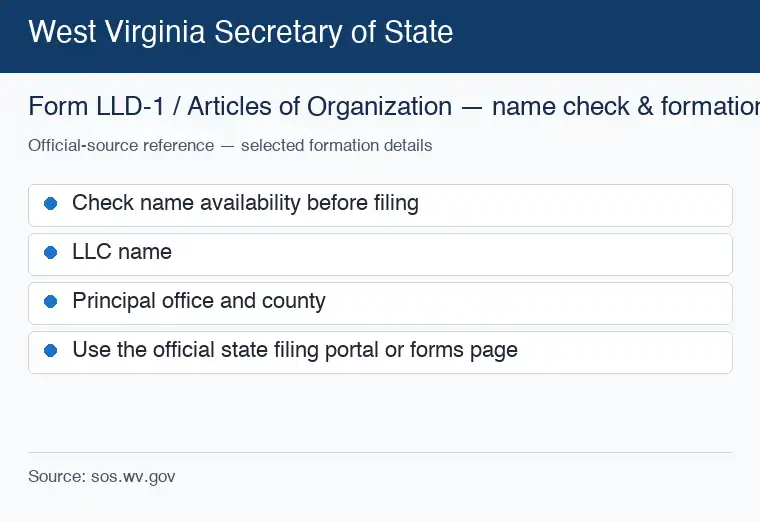
Your name must include "limited liability company" or a short form like "LLC" or "L.L.C." It also has to look different enough from every other name on file with the state.
Run your proposed name through the West Virginia LLC lookup tool first. A name that's already taken gets your filing rejected fast.
A few words need consent or a license before the state will accept them, so check the naming rules below before you settle on one. If you're not ready to file, reserve your name for $15 instead. That hold lasts 120 days.
Step 2: Appoint a registered agent (or decide to skip it)
The agent rule here is unusual: state law only says an LLC "may" name an agent for service of process [1]. Skip it, and the state fills in for you instead.
A named agent gives you a direct point of contact instead of routing legal mail through the state office, which helps if you're hard to reach at your own address.
You can also hire out the job. Registered agent services in West Virginia can take it on. So can any WV resident, a domestic corporation or an authorized foreign company.
Step 3: File the Articles of Organization with the West Virginia Secretary of State
This document is what legally creates your LLC in the eyes of the state. Check the facts box above for the exact filing fee and the small extra charge that applies if you file online.
The next section covers every field on the form and what happens after you submit it. It follows the same path as our guide to how to start an LLC, just adapted to West Virginia's own form and fee.
If you'd rather have an LLC formation service in West Virginia handle the paperwork, this is the step they take over.
Step 4: Create an operating agreement
An operating agreement isn't required in West Virginia. It doesn't even have to be in writing [2]. Skip it, and Chapter 31B's default rules take over instead.
Those rules decide how profits split, how members vote and what happens if someone leaves. A short written agreement puts you back in charge of those calls.
Step 5: Get an EIN
An EIN from the IRS is free, and the online application issues your number right away once it's approved. You'll enter this EIN when you apply for your West Virginia Business Registration Certificate in the next step.
Step 6: Get your West Virginia Business Registration Certificate
Every business in West Virginia needs this $30 certificate from the State Tax Division, your new LLC included. Apply through the same One Stop Business Portal you used for your Articles of Organization. Once it's issued, it never expires unless your name or address changes.
Filing the Articles of Organization in West Virginia: What to Expect
This is the detailed version of Step 3. It covers every field on the form, how the state handles your money and what happens after you submit.
1. What the form asks for
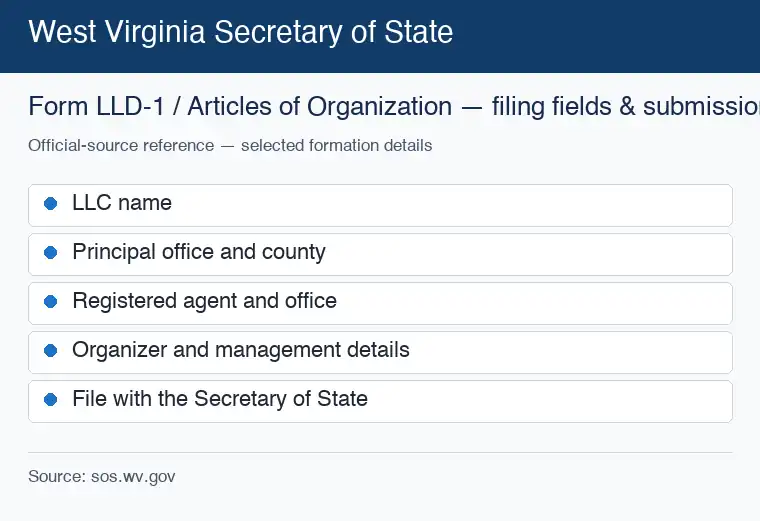
The form asks for your LLC's name and your principal office address and county. Add a mailing address if it's different. List your initial office in West Virginia too, if you have one, plus your agent's name and address if you're naming one.
It also wants an email address and a website, if you have one. List at least one organizer's name and address.
Say whether the company is member-managed or manager-managed, and name whoever holds signing authority. Last, it asks for your business purpose and your requested start date.
2. Fee and payment methods
The fee is $100, plus $1 more if you file online. Pay by check, money order or cashier's check made out to the Secretary of State.
Cards work too, and so does cash in person, though the office won't take $100 bills. A prepaid account works if you keep at least $300 in it.
3. Processing times
Online filings often clear right away or within a few days. Mail filings take the standard 5-10 business days. Same-day service in person costs an extra $25.
| Filing method | Processing time |
|---|---|
| Online | Often processed immediately, otherwise within a few business days |
| Standard processing: 5-10 business days, no additional cost | |
| In person | Same-day, for an additional $25 in-person expedite fee |
| Expedited | 24-hour (Next Business Day): +$25, 2-hour: +$250, 1-hour: +$500 |
| Current state estimate | Not published. The Secretary of State's business pages carry no dated backlog or "filings received on" notice |
If you need it faster still, expedited service adds $25 for next-business-day handling, $250 for a 2-hour turnaround or $500 for the 1-hour option. Our page on how long it takes to form an LLC in West Virginia tracks these windows in more depth.
4. Where to file by mail or in person
Mail your completed Articles of Organization, with payment, to the WV One Stop Business Center at 13 Kanawha Blvd. W., Suite 201, Charleston, WV 25302.
You can also file in person at the North Central WV Business Hub in Clarksburg or the Eastern Panhandle Business Hub in Martinsburg.
5. Common reasons filings are rejected
A Professional LLC application gets rejected without the signed Verification of Eligibility from your licensing board. Reinstatement filings come back if the required state tax standing letter is missing. Any filing with the wrong fee gets returned too, so check the fee schedule first.
6. What you receive when it is approved
File online, and you get confirmation through the One Stop Business Portal. File on paper with two originals and a return method, and the state mails, emails or hands back a filed, stamped copy.
What It Costs to Start an LLC in West Virginia
The state filing fee and the Business Registration Certificate are the two mandatory costs to start an LLC in West Virginia. Everything else below is optional, or it comes due later.
| Cost item | Amount |
|---|---|
| State filing fee | $100 online (plus a $1.00 online processing fee) or $100 by mail |
| Name reservation | $15.00, reserves the name for 120 days (renewable once for another 120 days) |
| Registered agent | $0 when a member or manager serves, since West Virginia does not require an agent at all. No state-set commercial-agent price is published |
| Certified copy | $15.00 (plus $5.00 for each additional amendment or document) |
| Expedited filing | 24-hour: +$25.00, 2-hour: +$250.00, 1-hour: +$500.00 (in addition to the standard filing fee) |
| Annual report | $25 filing fee, due by July 1 each year (filing window opens January 1) |
| Other mandatory state fees | $30.00 Business Registration Certificate fee (WV State Tax Division, one-time, permanent) |
A name reservation, certified copies, expedited service and a commercial agent are all optional. The Business Registration Certificate from Step 6 is the other mandatory cost. See our full breakdown of what it costs to form an LLC in West Virginia for other costs.
West Virginia-Specific Rules That Change the Process
1. Naming restrictions and restricted words
West Virginia bans "banking" and "insurance" from a name unless the company actually works in that field. "Engineer" needs a WV-licensed engineer among the principals. The state bans "911" outright, too.
2. Professional LLC rules
Licensed professionals can form a Professional LLC instead of a regular one. That covers engineers and other trades listed under Chapter 30 of the state code. The name must include "professional limited liability company" or "PLLC," and every member must hold the license.
The company must also carry $1 million of professional liability insurance [3]. Skip the signed Verification of Eligibility form from your licensing board, and the filing gets rejected outright.
3. Member vs. manager disclosure
West Virginia's Articles of Organization name whoever holds signing authority, whether that's your members or your managers. You'll list the same names and addresses again on every annual report. Either way, that record stays public.
4. Publication and initial report
No newspaper notice is required to form an LLC here, and there's no separate initial report either. Your first filing after formation is just the annual report, due the following July 1.
5. Business tax
No entity-level franchise or privilege tax applies just for existing as an LLC in West Virginia. Your LLC is taxed as a pass-through entity by default, the same as it is federally.
Profits flow straight to members' personal returns, and you'll still register to file the right West Virginia LLC taxes once you're running.
6. Foreign LLC registration
An LLC formed in another state uses the Application for Certificate of Authority (Form LLF-1) to register here. The fee is $150 [4].
7. Reinstatement and late filing
Miss your annual report, and the state can dissolve your LLC. Reinstating takes Form LLD-10, a $25 reinstatement fee and every missed year's $25 report fee. Late fees add up too: $50 a year for a for-profit LLC, or $25 for a nonprofit.
You'll also need the signed report and a Letter of Good Standing from the State Tax Division. If reinstatement is off the table, our guide to dissolving an LLC in West Virginia covers the alternative.
What to Do After Your West Virginia LLC Is Approved
Getting approved by the Secretary of State is a milestone, but a few follow-up moves keep your LLC in good standing.
Handle licenses and permits. Your Business Registration Certificate covers state-level registration. Check with your county or city for any local license your trade needs, and check your licensing board for occupational rules.
Register for state taxes. Sign up through the One Stop Business Portal for whatever your business needs: sales tax, employer withholding or unemployment coverage.
Keep your books separate from day one. It makes tax filings, the annual report and any future loan application far less painful.
If your agent, address or management ever changes, update your registered agent in West Virginia with the state so mail keeps reaching you. Put your annual report deadline on the calendar the day you're approved, and check the schedule below every year.
| Compliance item | Deadline, fee and department |
|---|---|
| Initial report | None required. West Virginia has no separate initial report. The first annual report is due by the following July 1 |
| Annual or biennial report | $25, due July 1 each year, filed through the One Stop Business Portal with the Secretary of State |
| State tax registration | Business Registration Certificate ($30) from the WV State Tax Division, applied for through the One Stop Business Portal |
| Renewal deadline | Not applicable: the Business Registration Certificate is permanent and does not expire unless the business changes its name or location |
| Late fee | $50 per year late fee for for-profit LLCs missing the annual report ($25 per year for non-profits). Missed reports lead to administrative dissolution, reversible with a Form LLD-10 reinstatement |
| Responsible state department | West Virginia Secretary of State, Business & Licensing Division (filings) and West Virginia State Tax Division (tax registration) |
FAQs
Do I Have to Appoint a Registered Agent for a West Virginia LLC?
No, appointing a registered agent isn't mandatory for a West Virginia LLC. Skip it, and the Secretary of State fills that role automatically, standing in to receive legal notices on your behalf.
Does a West Virginia Professional LLC Need Special Insurance?
Yes, a West Virginia Professional LLC needs special insurance: $1 million of professional liability coverage before the state will approve the filing.
How Do I Register a Foreign LLC to Do Business in West Virginia?
You register a foreign LLC to do business in West Virginia by filing Form LLF-1 with the Secretary of State and paying a $150 fee.
Does West Virginia Charge Extra for Same-Day LLC Filing?
Yes, West Virginia charges extra for same-day LLC filing. Same-day and next-business-day service both add $25, while the 2-hour and 1-hour options cost $250 and $500.
References:
- https://code.wvlegislature.gov/31B-1-108/
- https://code.wvlegislature.gov/31B-1-103/
- https://code.wvlegislature.gov/31B-13-1305/
- https://code.wvlegislature.gov/31B-10-1002/