How to Start an LLC in Alaska (2026)

To start an LLC in Alaska, you file Articles of Organization (Form 08-484). You send it to the Alaska Division of Corporations, Business and Professional Licensing. The filing fee is $250. Filing also triggers Alaska's own initial report requirement, due within six months of formation.
This page walks through forming a brand-new domestic Alaska LLC. An LLC that already exists in another state registers as a foreign LLC instead, on Form 08-497 for a $350 fee. The FAQs below cover that process.
Quick Summary
- A member can serve as your own registered agent. Just know a home address becomes part of the public record.
- File your biennial report on time. Waiting too long risks involuntary dissolution, even though the state sends written notice first.
- Don't stop at the Articles of Organization. Alaska still expects an initial report and a separate business license before you're done.
Alaska LLC Requirements at a Glance
The table below lists the exact form, agency, fee, filing method and deadlines Alaska expects from a new LLC. Check every number here before you file.
| LLC requirement | State-specific answer |
|---|---|
| Filing document | Articles of Organization, Form 08-484 (AS 10.50.075) |
| Filing authority | Alaska Division of Corporations, Business and Professional Licensing, Corporations Section (Dept. of Commerce, Community and Economic Development) |
| State filing fee | $250.00 (same online and by mail) |
| Online filing | Yes, the Corporations Section's online filing system |
| Processing time | Online: posted immediately. Mail: 10-15 business days (March-September), 15+ business days (October-February) |
| Registered agent | Alaska resident, or a corporation allowed to do business in Alaska (AS 10.50.055). Can't be an LLC. Needs both a physical and a mailing address in Alaska |
| Annual report | Biennial Report (not annual): $100.00, due before January 2 of the filing year matching the LLC's formation year (odd/even), delinquent if not filed before February 1 |
| Publication required? | No. AS 10.50's only newspaper-notice mechanism (AS 10.50.440) is an optional creditor-claim cutoff used at dissolution, separate from forming an LLC |
| State business tax | No franchise, privilege or gross-receipts tax on pass-through LLCs. Alaska's Corporate Net Income Tax applies only if the LLC elects corporate tax treatment (Dept. of Revenue, Tax Division) |
| Last verified | September 3, 2026 |
How to Start an LLC in Alaska: 6 Steps
These are the six actions Alaska requires to form your LLC. Each one is covered in detail below, from naming your business to filing your first report.
Step 1: Choose and check your LLC name
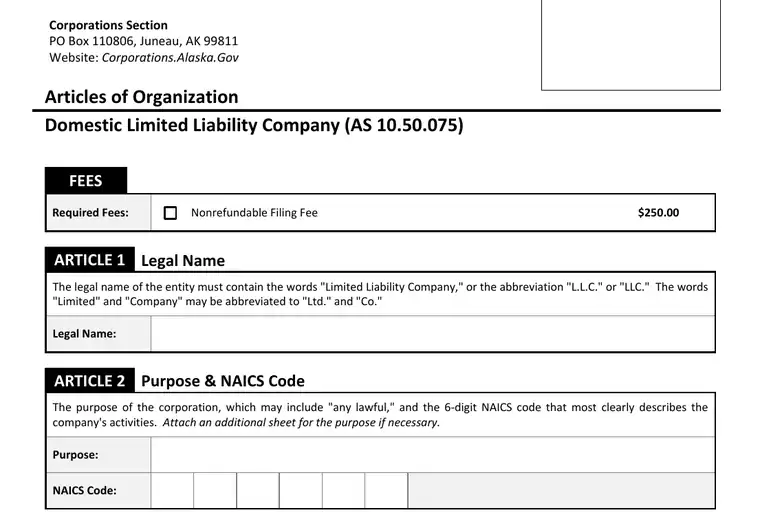
Your name must contain "limited liability company," "LLC" or "L.L.C." You can abbreviate "limited" as "Ltd." and "company" as "Co." It also has to be distinguishable from every other name on file with the Division.
Search it in the Corporations Database first. A name too close to one already on file gets your filing rejected.
You can look up any existing Alaska LLC the same way, covered in our guide to looking up an LLC in Alaska. If you're not ready to file yet, you can reserve a name for 120 days for $25.
Step 2: Appoint a registered agent
Alaska requires every LLC to keep an agent and a registered office in the state at all times. [1] Your agent can be an Alaska resident whose home or office matches that address.
It can also be a corporation allowed to do business in Alaska. An LLC can't act as its own agent. Both a physical address and a mailing address in Alaska are required.
Serving as your own agent costs nothing, but it puts a real street address on the public record. If you'd rather not, compare options in our best registered agent services in Alaska roundup.
Step 3: File the Articles of Organization
This is the document that legally creates your LLC. It's filed only with the Division of Corporations, Business and Professional Licensing.
You can file online or by mail. Online filings post right away. Our guide to starting an LLC walks through the broader process step by step.
If you'd rather have a service handle the filing, compare options in our best LLC services in Alaska roundup. Up next is a full field-by-field walkthrough of that form and what Alaska sends back once it's approved.
Step 4: Create an operating agreement
Alaska doesn't require an operating agreement. The Division won't even file one if you send it in. That doesn't make it optional in practice.
Without one, Alaska's default LLC rules decide how your company is managed and who can act for it. Alaska law treats an operating agreement as a written agreement among all members. A handshake deal won't carry the same weight as a signed document.
Step 5: Get an EIN
Apply for your EIN directly at irs.gov. It's free. Approved online applications get their number right away. You'll need it on file before applying for the state Business License. You'll need it again if you elect Alaska's Corporate Net Income Tax.
Step 6: File your initial report
New LLCs must file an initial report within six months of formation. It's filed online through the same Corporations Section system, and there's no fee. Skipping it puts your LLC out of compliance before your first biennial report is even due.
Filing the Articles of Organization in Alaska: What to Expect
Here's what actually happens when you submit the Articles of Organization, field by field. This covers everything from what the form asks for to what you get back once it's approved.
1. What the form asks for
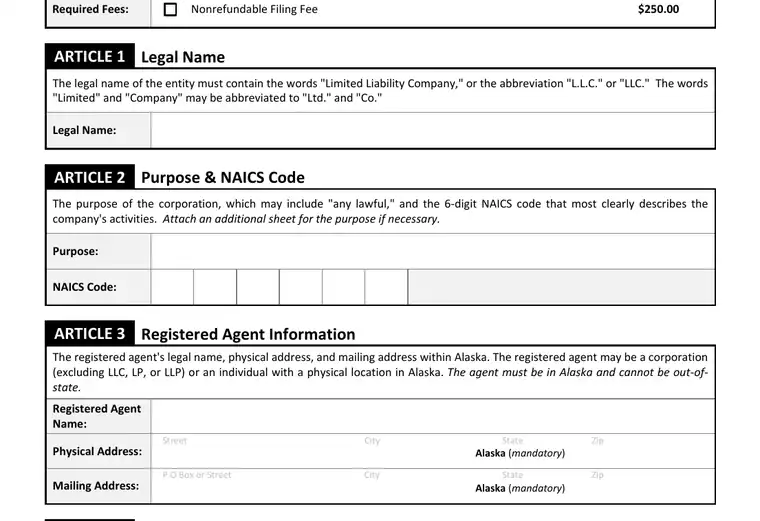
The Articles of Organization ask for five things. Article 1 is your LLC's name. Article 2 is your business purpose, which can just say "any lawful purpose," plus a six-digit NAICS code.
Article 3 is your agent's name, physical address and mailing address in Alaska. Article 4 asks whether members or a manager will run the company.
Article 5 leaves room for optional provisions if you need them. One or more organizers sign and date the form at the end.
2. Fee and payment methods
The filing fee is $250. It doesn't change based on how you submit the form. Online filers pay by major credit card. Mail filers can send the fee in U.S. dollars, or use the Division's Credit Card Payment Form instead of a check.
3. Processing times
Online filings post to the record right away. Expedited processing costs extra, but the Division doesn't post a specific turnaround for it.
Mail filings usually take 10 to 15 business days between March and September. They stretch to 15 or more business days between October and February, when the office sees more volume.
For how that compares with other states, see our guide to how long it takes to form an LLC in Alaska. The table below lists every filing method Alaska offers, including current fees and posted turnaround times.
| Filing method | Processing time |
|---|---|
| Online | Posted immediately |
| 10-15 business days (March-September), 15+ business days (October-February) | |
| In person | Not offered as a distinct channel. The Corporations Section names only online filing and mail filing as methods for the Articles of Organization |
| Expedited | Available for the $150.00 fee. No specific turnaround is published, only that expedited requests get priority over regular filings |
| Current state estimate | Not published as a dated backlog notice. The Corporations Section publishes only a seasonal standard range: 10-15 business days March-September, 15+ business days October-February |
4. Where to file by mail or in person
Mail your Articles of Organization to State of Alaska, Corporations Section, PO Box 110806, Juneau, AK 99811-0806. The Division's walk-in office is at 333 Willoughby Avenue, 9th Floor, State Office Building, Juneau, AK 99801-1770.
Alaska doesn't publish a separate in-person filing track. Documents dropped off there are processed in the same order as mailed filings.
5. Common reasons filings are rejected
Alaska doesn't spell out a specific list of common rejection reasons. Its own instructions warn that a posted filing becomes permanent, and state law gives the department 10 days to reject a filing and explain why in writing.
6. What you receive when it is approved
Approval creates a Certificate of Organization. If you filed online, you can view, save and print it right away from your entity's record in the Corporations Database.
If you filed by mail, the Division mails your processed Articles back once they clear the standard review queue in Juneau.
What It Costs to Start an LLC in Alaska
The table below breaks out every fee Alaska charges to form and maintain your LLC. For a fuller breakdown of what owners actually spend, see our guide to what an LLC costs in Alaska.
| Cost item | Amount |
|---|---|
| State filing fee | $250.00 (same online and by mail) |
| Name reservation | $25.00, reserves the name for 120 days (Form 08-559) |
| Registered agent | $0 when a qualifying Alaska-resident member or manager serves personally (AS 10.50.055). No state fee to name one at formation. Changing agents afterward costs $25.00 (Form 08-492) |
| Certified copy | $5.00 to certify a document as a true and correct copy, requested on the Copy Request Form 08-562 |
| Expedited filing | $150.00 additional fee for expedited filing, on top of the standard state filing fee |
| Annual report | Biennial Report (not annual): $100.00, due before January 2 of the filing year matching the LLC's formation year (odd/even), delinquent if not filed before February 1 |
| Other mandatory state fees | Alaska Business License required to operate: $50.00 for a 1-year license or $100.00 for a 2-year license (AS 43.70.020), separate from the LLC filing fee |
Name reservation, a certified copy and expedited filing are the only costs on this list you can skip. Expedited processing costs an extra $150 if you want it.
The biennial report and the state business license are mandatory costs if you want your LLC to keep operating legally in Alaska.
Alaska-Specific Rules That Change the Process
1. Naming rules and restricted words
Your name can include a city, borough or village name. It just can't contain the word "city," "borough" or "village," or otherwise suggest your LLC is a government unit.
It also can't mislead people about what your business actually does. A name with a professionally restricted word, like "Engineer," needs the matching professional license behind it.
2. Professional LLC rules
Alaska doesn't have a separate professional LLC statute. The LLC Act already lets you organize for any lawful purpose, including the rendering of a professional service.
Licensed professionals form a regular LLC. They answer to their own licensing board instead of filing a different kind of entity.
3. Member vs. manager disclosure
The Articles of Organization only ask whether members or a manager will run your LLC. No names go on that form.
Your biennial report is different. It has to list the managers, or the members if there's no manager, plus anyone who owns 5% or more of the company. That information becomes public record.
4. Business license system
Filing your Articles of Organization doesn't give you permission to operate. You'll also need a separate state Business License. [2] It's issued by the same Division and stays good through December 31 of its final year.
5. Reinstatement after a missed biennial report
Alaska can shut down your LLC in four cases, without you asking for it. Your biennial report is six months late, or you go 30 days without a registered agent.
You also risk it if you change your registered agent or office and skip the 30-day statement of change, or if you misrepresent facts on a filing. You get written notice first.
You can fix the problem within two years of dissolution. Just pay double what you owed plus whatever else would have come due. If closing the LLC is what you want instead, see our guide to dissolving an LLC in Alaska.
What to Do After Your Alaska LLC Is Approved
Open a business bank account once you have your filed Certificate of Organization and your EIN in hand. Keep digital copies of both on hand.
Apply for the state Business License before you take your first paying customer. It's a separate application from the Articles of Organization. The Division issues both from the same office.
Alaska has no state sales tax or personal income tax. You can still elect to have your LLC taxed as a corporation instead of the default pass-through treatment. The FAQs below cover what that means for Alaska's Corporate Net Income Tax.
Set up a simple bookkeeping system before money starts moving through the LLC. It makes the biennial report and any tax filings far easier to finish on time.
Put your biennial report and your business license renewal on a calendar now. If your registered agent ever changes, our guide to changing a registered agent in Alaska covers that filing too.
Here's every recurring deadline Alaska attaches to an LLC after formation. It runs from the report you file first to the one that keeps your business license active.
| Compliance item | Deadline, fee and department |
|---|---|
| Initial report | Required within 6 months of original organization, filed online, no fee |
| Annual or biennial report | Biennial Report, $100.00, due before January 2 of the applicable odd/even year matching the LLC's formation year. Delinquent if not filed before February 1 |
| State tax registration | Alaska Business License (AS 43.70.020) with the Division of Corporations, Business and Professional Licensing. No state sales tax or income tax registration applies. LLCs that elect corporate tax treatment register with the Dept. of Revenue instead |
| Renewal deadline | Business License expires December 31 of its 1- or 2-year term and must be renewed by that date |
| Late fee | $25 late charge for each year or part of a year the biennial report is delinquent, plus 10 percent of the filing fee (3 AAC 16.065(c)-(d)). Six months' delinquency risks involuntary dissolution (AS 10.50.408(a)(1)) |
| Responsible state department | Alaska Division of Corporations, Business and Professional Licensing (filings, biennial report, business license) and Alaska Department of Revenue, Tax Division (Corporate Net Income Tax) |
FAQs
Is an Annual Report Required for an Alaska LLC?
No, an annual report is not required for an Alaska LLC. Alaska calls for a biennial report every two years instead. It's due before January 2 of the matching odd or even year, with a $100 fee.
Does Alaska Charge a Franchise Tax on LLCs?
No, Alaska doesn't charge a franchise tax on LLCs taxed as pass-through entities. Its Corporate Net Income Tax only applies in one case. Your LLC must elect to be taxed as a corporation.
Can I Move an Existing LLC Into Alaska?
Yes, you can move an existing LLC into Alaska by registering it as a foreign LLC instead of forming a new one. That filing costs $350 and goes to the same Division that handles domestic Articles of Organization.
What Happens If I Miss Alaska's Initial Report?
If you miss Alaska's initial report, your LLC falls out of compliance right away, even though the report itself carries no fee. Ignore compliance long enough and you risk the same involuntary dissolution a missed biennial report triggers.
Does Alaska Require a Separate State Business License?
Yes, Alaska does require a separate state Business License, on top of your Articles of Organization. It costs $50 for one year or $100 for two. The same Division issues it once you're ready to operate.
Can I Reserve My Alaska LLC Name Before Filing?
Yes, you can reserve your Alaska LLC name before filing, for $25 through the Division of Corporations. The reservation holds it for 120 days while you get the rest of your paperwork ready.
References:
- https://www.commerce.alaska.gov/web/portals/5/pub/corporationsstatutesandregulations.pdf
- https://www.commerce.alaska.gov/web/Portals/5/pub/BusinessLicenseStatutes.pdf