How to Start an LLC in Oklahoma (2026)

You form an LLC by filing Articles of Organization with the Oklahoma Secretary of State's Business Filing Department. The fee is $100. After that, the state keeps you on file with a $25 Annual Certificate due each year on your filing's anniversary.
This guide walks a new domestic LLC through naming the business and appointing a registered agent. Then it covers filing the Articles and the rules that follow after approval.
If you already run an LLC formed in another state, moving it into Oklahoma is a foreign LLC registration. The state-specific rules section below covers it in full.
Quick Summary
- Search the Secretary of State's name database first. A name too close to one on file gets rejected.
- Oklahoma's registered agent can be an individual resident, a qualifying entity or the LLC itself. That address becomes part of the public record right away.
- Oklahoma emails your Annual Certificate reminder instead of mailing it. Missing it risks your LLC's good standing.
Oklahoma LLC Requirements at a Glance
These are the numbers and rules that shape an Oklahoma LLC filing. They're gathered in one table so you don't have to hunt for them.
| LLC requirement | State-specific answer |
|---|---|
| Filing document | Articles of Organization (SOS Form 0074), filed under Title 18 Section 2005 |
| Filing authority | Oklahoma Secretary of State, Business Filing Department |
| State filing fee | $100 |
| Online filing | Yes, Online Business Filing at sos.ok.gov |
| Processing time | Not published for online or mail (filed in the order received). Same-day in-person service: $50 if dropped off before 4:30 pm CT |
| Registered agent | The LLC itself, an Oklahoma resident or a qualified domestic or foreign entity, with a street-address office open during business hours (P.O. Boxes don't qualify) |
| Annual report | Annual Certificate, $25/year, due each year on the LLC's formation anniversary, emailed 60 days ahead with a 60-day grace period |
| Publication required? | No. Oklahoma's LLC Act has no newspaper-publication requirement |
| State business tax | None. Oklahoma's franchise tax, which only ever applied to corporations, has been fully repealed and never applied to LLCs |
| Last verified | September 4, 2026 |
How to Start an LLC in Oklahoma: 5 Steps
Oklahoma's process needs only five steps, not six. It still follows the same basic order for forming an LLC used elsewhere.
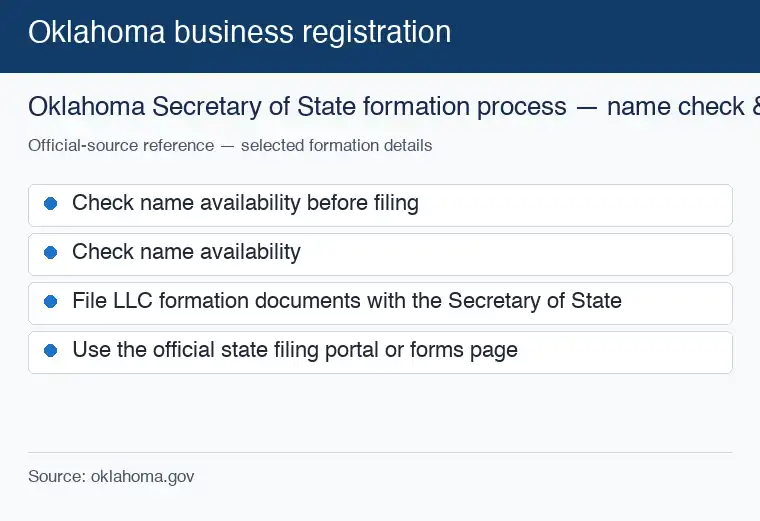
Step 1: Choose and check your LLC name
Your LLC's name needs one of a few tags: LLC, L.L.C., LC or L.C. You can also spell it out as "limited liability company" or "limited company."
Either way, it can't be too close to a name Oklahoma already has on file. That check goes back three years.
Run a candidate name through the Secretary of State's business name search first. It catches conflicts before you pay any fee. Our guide on how to look up an LLC in Oklahoma walks through that same tool.
A $10 reservation holds a name for 60 days. That buys you time if the rest of your paperwork isn't ready yet.
Step 2: Appoint a registered agent
Your registered agent has to be the LLC itself, an Oklahoma resident or a qualified domestic or foreign entity [1]. That agent needs a real street-address office in the state.
The office has to stay open during regular business hours. That way it can accept paperwork in person. P.O. Boxes don't work for this.
Our roster of registered agent services in Oklahoma covers the commercial options. Use one of those if you'd rather not list your own address.
Step 3: File the Articles of Organization with the Secretary of State
Send Form 0074 to the Business Filing Department. File it through the Secretary of State's online system or by mail. The next section breaks down every field the form asks for.
A formation service can also handle the filing for you. Check our picks for the best LLC services in Oklahoma to compare options.
Step 4: Create an operating agreement
State law doesn't make you put one in writing. Oklahoma's own definition covers oral, implied and written agreements among members alike. Skip one, and the Act's own default terms simply take over.
Step 5: Get an EIN
Once the state approves your LLC, apply for an EIN through the IRS website at irs.gov. It's free, and the online tool issues your number right away. You'll need it in hand before you can register with the Oklahoma Tax Commission.
Filing the Articles of Organization in Oklahoma: What to Expect
Here's what happens once you actually sit down with the paperwork, field by field. It starts with what the state expects on the form itself.
1. What the form asks for
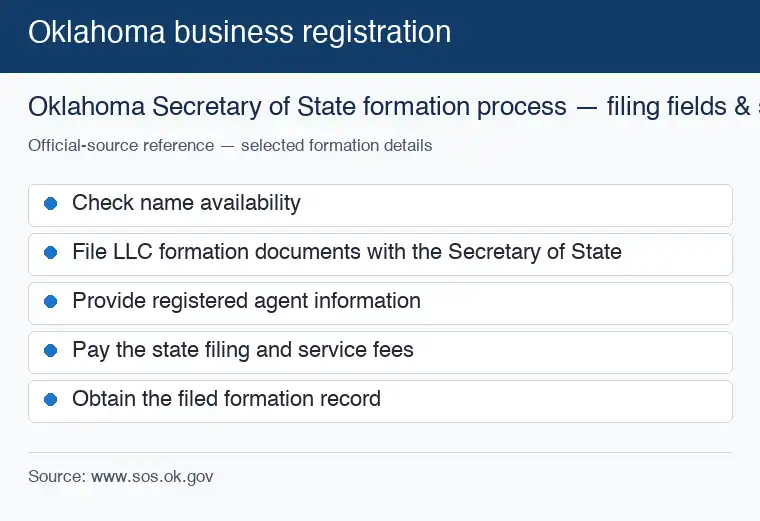
Form 0074 wants your LLC's name and the street address of its principal place of business. It also wants an email address for the company's primary contact. Add your registered agent's name and street address, plus how long the LLC will exist.
Like the registered office, the principal business address has to be a real street address. The form doesn't accept a P.O. Box there either.
The term of existence can run perpetual. It can also last a set number of years or end on a future date you name. At least one organizer signs the articles.
2. Fee and payment methods
The filing fee is $100, whether you mail it in or file online. Mail a check, cashier's check or money order made payable to the Oklahoma Secretary of State.
You can also pay by Visa, Discover, MasterCard or American Express if you're filing in person or online. Cards add a 4% service charge on top of that. Budget for it.
3. Processing times
The Business Filing Department doesn't publish a standard number of days for online or mailed filings. It just processes documents in the order they arrive.
Same-day service costs $50 per document when you drop it off in person before 4:30 pm CT. Oklahoma's timeline looks different once you set it beside other states. Our page on how long it takes to form an LLC in Oklahoma walks through that comparison.
| Filing method | Processing time |
|---|---|
| Online | Not published. Filings are processed in the order received |
| Not published. Filings are processed in the order received | |
| In person | Same day if presented before 4:30 pm CT (for the $50 fee). After that, the next business day |
| Expedited | $50 per document for in-person Same Day Service. No mail-in expedite tier is offered |
| Current state estimate | Not published. No backlog or turnaround notice appears on the Business Filing Department's pages |
4. Where to file by mail or in person
Mail or deliver the Articles to the Business Filing Department, Oklahoma Secretary of State, 421 N.W. 13th, Suite 210, Oklahoma City, OK 73103. Walk-in filings use the same address, and same-day service applies only there.
5. Common reasons filings are rejected
The department doesn't publish a specific list of common rejection reasons. Based on the form's own requirements, likely culprits include a name too similar to one already on record. Other common ones are a bad registered agent address or articles nobody signed.
6. What you receive when it is approved
By default, the Secretary of State mails your filed, stamped Articles back to you. It goes to whatever address you listed on the form.
If you'd rather not wait on the mail, attach a request to receive your documents electronically instead. That sends an email link where you download the filed copy yourself.
What It Costs to Start an LLC in Oklahoma
The facts box above already covers Oklahoma's mandatory filing fee. Everything in the table below is optional or only kicks in under certain circumstances.
| Cost item | Amount |
|---|---|
| State filing fee | $100 |
| Name reservation | $10 for a 60-day reservation |
| Registered agent | $0 if a member, manager or the LLC itself serves as agent. $40/year only if the Secretary of State is designated as agent |
| Certified copy | $10 |
| Expedited filing | $50 per document for in-person Same Day Service (before 4:30 pm CT) |
| Annual report | Annual Certificate, $25/year, due each year on the LLC's formation anniversary, emailed 60 days ahead with a 60-day grace period |
| Other mandatory state fees | None beyond the $100 filing fee and the $25 Annual Certificate. Oklahoma charges no separate initial-report or publication fee |
A name reservation only matters if you need to lock a name down early. That 60-day window gives you room while the rest of your paperwork comes together. A certified copy costs $10, worth ordering only when a bank or lender specifically asks for one.
Same-day service costs $50 per document if you drop it off before 4:30 pm CT. A deadline you can't move is the only reason to pay for it.
Serving as your own registered agent costs nothing extra. But your address becomes part of Oklahoma's public record. Hiring a commercial agent instead keeps your address off that record. See our guide on how much an LLC costs in Oklahoma for the full breakdown.
Oklahoma-Specific Rules That Change the Process
1. Naming restrictions and restricted words
Oklahoma's LLC Act only sets a designator rule and a rule against duplicate names. It doesn't publish a list of banned or restricted words the way some states do.
There's no newspaper publication requirement once your LLC is formed, unlike in some other states. You won't pay for or place a notice anywhere.
2. Professional LLC rules
Licensed professionals organize under a separate law, the Professional Entity Act. The entity's name has to end with a modified designator like "P.L.L.C."
The profession's own licensing board must certify that every owner or manager is properly licensed. Professional LLCs can't file through the online system, so you'll use the paper form instead.
3. Member vs. manager disclosure
The Articles of Organization don't name your members or managers at all. They disclose only your registered agent's name and address, plus the signature of whoever organizes the LLC. That person doesn't need to be a member.
4. Registered agent changes and reinstatement
Any manager can file a change of registered agent or registered office with the Secretary of State. If you'd rather switch providers, you don't have to manage that paperwork yourself. See how to change a registered agent in Oklahoma.
Go more than 60 days past your Annual Certificate due date and the LLC loses good standing. Getting it back takes filing every certificate you owe and paying the fees attached to them. You'll also submit a reinstatement application. It carries no fee.
5. Business taxes and foreign LLC registration
Oklahoma charges no franchise, privilege or gross-receipts tax on LLCs. Lawmakers fully repealed the state's franchise tax. It only ever applied to corporations, so it no longer touches any business at all [2].
A default LLC owes no entity-level state income tax either. Profits simply pass through to the members' own personal returns.
You'll still register with the Tax Commission for sales tax if you sell taxable goods or services. Hiring anyone means registering for withholding tax too.
Bringing an LLC formed in another state into Oklahoma means registering as a foreign LLC. That's a $300 Registration of Foreign Limited Liability Company. The same department that handles domestic filings processes it.
What to Do After Your Oklahoma LLC Is Approved
A bank will want your Oklahoma-filed, stamped Articles and your free IRS EIN before it opens a business account. Oklahoma has no general state license requirement. Your profession's board, city or county might still require one, depending on what you do and where you're located.
Selling taxable goods or bringing on your first employee is your cue to register with the Tax Commission. Use OkTAP for whichever accounts apply to your business.
From here on, put your Annual Certificate on repeat in your calendar. It's the recurring filing every Oklahoma LLC owes, with the deadline and late-fee details in the table below.
| Compliance item | Deadline, fee and department |
|---|---|
| Initial report | None required. The first periodic filing is the Annual Certificate, due on the LLC's formation anniversary |
| Annual or biennial report | Annual Certificate, $25/year, due on the LLC's formation anniversary (Title 18 Section 2055.2) |
| State tax registration | Register with the Oklahoma Tax Commission (OkTAP) for sales tax (if selling taxable goods) and withholding tax (if hiring employees) |
| Renewal deadline | Not applicable. Oklahoma has no general state business license to renew |
| Late fee | None published. After the 60-day grace period the LLC loses good standing until it pays the delinquent $25 fees and files a no-fee reinstatement application |
| Responsible state department | Secretary of State's Business Filing Department for the Annual Certificate. Oklahoma Tax Commission for tax registrations |
FAQs
How Is Oklahoma's Annual Certificate Different From a Typical Annual Report?
Oklahoma's Annual Certificate functions like a typical annual report. It's due on your own LLC's formation anniversary instead of one fixed date for every business. You'll get the renewal notice by email rather than by mail.
Can I Be My Own Registered Agent in Oklahoma?
Yes, you can be your own registered agent in Oklahoma as long as you keep a street address open during regular business hours. Naming yourself costs nothing extra, unlike paying a commercial agent's fee.
Will My Name Show Up on Public Records After Forming an Oklahoma LLC?
No, your name won't show up on public records from forming an Oklahoma LLC. Oklahoma's Articles of Organization identify only your registered agent and the person who organizes the LLC, never the members or managers who own it.
Is There a Franchise Tax on Oklahoma LLCs?
No, there's no franchise tax on Oklahoma LLCs. State lawmakers eliminated it completely, and even when it existed, only corporations paid it, not LLCs.
References:
- https://www.oklegislature.gov/OK_Statutes/CompleteTitles/os18.pdf
- https://oklahoma.gov/tax/newsroom/2023/07-26-23.html