How to Start an LLC in Connecticut (2026)

Connecticut LLCs form by filing a Certificate of Organization with the Secretary of the State's Business Services Division. The fee is $120.
One rule trips people up: your annual report isn't tied to your formation date. It lands on a fixed calendar window every year instead. This guide covers forming a brand-new domestic LLC, from picking a name through your first annual report.
If you already run an LLC elsewhere, registering it here is a foreign LLC registration. That's covered in the rules section below. Below you'll find the exact steps, the filing walkthrough and what everything costs. You'll also get the rules unique to this state and a compliance calendar.
Quick Summary
- Check your name before you file. It must differ from any other name the state has on record.
- The annual report follows a fixed yearly window rather than your formation date. Miss it for a year and forfeiture follows.
- A member or manager can serve as your registered agent for free. Their home address then becomes part of the public record.
Connecticut LLC Requirements at a Glance
Connecticut's fee schedule and its own forms set every number below. That covers the filing document, the fee and the state business tax an LLC owes.
| LLC requirement | State-specific answer |
|---|---|
| Filing document | Certificate of Organization (Domestic LLC) |
| Filing authority | Secretary of the State, Business Services Division |
| State filing fee | $120 |
| Online filing | Yes, Business.CT.gov |
| Processing time | Online is usually fastest, with 24-hour expedited service for $50. Mail and in-person filing is slower, and the agency publishes no fixed day count. |
| Registered agent | A Connecticut resident, or a CT-registered business entity, with a Connecticut address who signs on to accept the role. |
| Annual report | $80, filed online with the Secretary of the State each year from January 1 to March 31, starting the year after formation. |
| Publication required? | No. Connecticut requires no newspaper publication to form an LLC. |
| State business tax | None mandatory. Connecticut's former Business Entity Tax ended in 2018, and LLCs may elect the optional Pass-Through Entity Tax. |
| Last verified | September 3, 2026 |
How to Start an LLC in Connecticut: 5 Steps
Five steps take your LLC from idea to an approved, active entity. They cover the name, the agent, the filing and the paperwork that follows, in order.
Step 1: Choose and check your LLC name
Your name needs "limited liability company," "LLC" or "L.L.C." at the end. Limited can shorten to Ltd, and company to Co.
Your name also has to be different enough from any other active name. It's checked against the Secretary of the State's file. Check the Business.CT.gov business record database, or use our tool to look up an existing LLC in Connecticut.
Some LLCs need a different name. If yours renders a licensed professional service, it needs "professional limited liability company" or "PLLC" instead.
A few purposes are off-limits too. You can't organize as a bank, and selling insurance needs an Insurance Commissioner's certificate first.
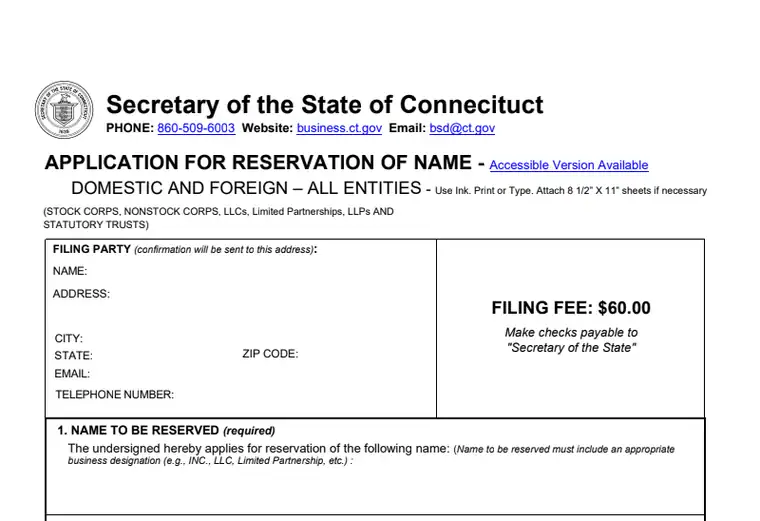
You can reserve a name before you're ready to file, so no one else grabs it first. It costs $60, and the reservation lasts 120 days.
Step 2: Appoint a registered agent
Each LLC here needs a registered agent to accept legal notices on its behalf [1]. That agent can be a state resident, including you or another member or manager.
It can also be a business entity already registered here, with an in-state address. Whoever you pick has to sign accepting the job. Your LLC can't act as its own agent.
A Connecticut registered agent service can take this off your plate. That way, a home address stays off the public record.
Step 3: File the Certificate of Organization with the Business Services Division
Submit your Certificate of Organization to the Business Services Division [2]. Pay online at Business.CT.gov or by mail.
The next section walks through what the form asks for and how to pay. If you'd rather hand the filing off, a Connecticut LLC formation service can file it for you.
Step 4: Create an operating agreement
The state doesn't require an operating agreement for your LLC. Yours can be oral, written or simply implied by how the members act day to day.
Write one anyway. It spells out how the LLC runs. The state's default rules only fill in whatever you leave out.
Step 5: Get an EIN
Apply for a free EIN online at irs.gov. You'll have it immediately to open a bank account or hire staff.
Filing the Certificate of Organization in Connecticut: What to Expect
Submitting the Certificate of Organization sets off a fixed sequence, covered field by field below. For the general steps most states share, see our guide to how to start an LLC.
1. What the form asks for
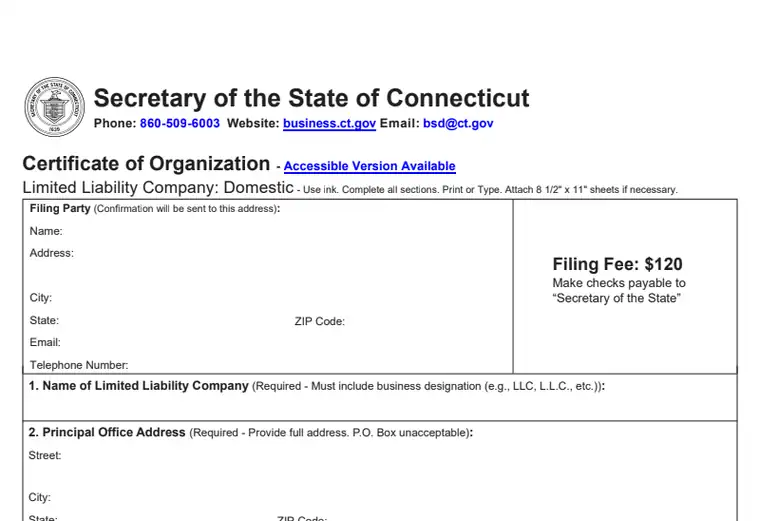
The form asks for your filing party's contact information and your LLC's name with its designator. It also wants a principal office address with no P.O. box, and a mailing address where a P.O. box is fine.
You'll also appoint your registered agent and get their signature. List at least one member or manager, with a business and residence address for each.
Provide an email address or check "none," and give a six-digit NAICS code. The organizer signs and dates the form last, and your LLC can't be its own organizer.
Only three member or manager names show up on the public record. The state releases more names only when someone requests a copy of the original filing.
2. Fee and payment methods
The filing fee is $120 no matter how you file. Pay online with Mastercard, Visa, Discover or American Express through Business.CT.gov.
Mail and in-person filings need a check or money order instead. Make it out to the Secretary of the State. Credit cards no longer work for anything mailed or hand-delivered.
3. Processing times
The state doesn't publish a fixed turnaround for standard filings. Online submissions are generally accepted right away, which makes them faster than mailing one in.
See our breakdown of how long it takes to form an LLC in Connecticut for more on timing. Expedited service adds a 24-hour turnaround for $50, available online only.
| Filing method | Processing time |
|---|---|
| Online | Not published as a fixed day count. The agency states most online filings are automatically accepted for faster processing. |
| Not published as a fixed day count. The agency describes mail filing as its slowest option and accepts only a check or money order. | |
| In person | Not published as a fixed day count. Documents may be hand-delivered to the Business Services Division's Hartford office at the same pace as mail. |
| Expedited | 24 hours per transaction, online filings only. |
| Current state estimate | Not published. No current backlog or turnaround notice appears on the agency's filing pages. |
4. Where to file by mail or in person
Mail your Certificate of Organization to Business Services Division, Connecticut Secretary of the State, P.O. Box 150470, Hartford, CT 06115-0470. To hand-deliver it instead, bring it to 165 Capitol Avenue, Suite 1000, Hartford, CT 06106.
5. Common reasons filings are rejected
The Business Services Division doesn't publish a list of common rejection reasons. Its own form does flag what it needs though.
That means a name that's different enough. It also means a signed registered agent, at least one member or manager and a signed organizer. Miss any of those and expect your filing back.
Double-check your registered agent's signature before you submit. A missing one is an easy way to send a filing back to you.
6. What you receive when it is approved
Confirmation goes to whatever address you listed as the filing party. Once accepted, your filing becomes available to download for free from your Business.CT.gov record. No login is required.
What It Costs to Start an LLC in Connecticut
Forming and keeping an LLC here comes with a specific set of costs, broken down below. See our complete Connecticut LLC cost breakdown for more detail on any of these.
| Cost item | Amount |
|---|---|
| State filing fee | $120 |
| Name reservation | $60. The reservation lasts 120 days. |
| Registered agent | $0 when a Connecticut-resident member, manager or other individual serves and signs the acceptance. The state does not publish a commercial registered-agent fee. |
| Certified copy | $40 per document copy plus $15 to certify it ($55 total). |
| Expedited filing | $50 per transaction for 24-hour service, online filings only (not available for mailed filings). |
| Annual report | $80, filed online with the Secretary of the State each year from January 1 to March 31, starting the year after formation. |
| Other mandatory state fees | None. Connecticut charges no separate initial report, business privilege tax or publication fee to form or keep an LLC. |
Only two of these are truly mandatory: the filing fee and the annual report. Everything else on this list is optional, so skip what you don't need.
Connecticut-Specific Rules That Change the Process
A handful of Connecticut-specific rules affect how the whole process plays out. They cover naming, professional licensing, disclosure, publication and taxes.
1. Naming restrictions and restricted words
Your name must be different from any other active firm on the Secretary of the State's records. It also can't imply a purpose your LLC doesn't actually have.
The state blocks a few business purposes outright, including banking under Title 36a. Telegraph, gas, electric, water and cemetery businesses are off the table too.
Selling insurance, surety or indemnity coverage needs an Insurance Commissioner's certificate and license first. Get that before you file anything else.
2. Professional LLC (PLLC) rules
Your LLC may need to render a licensed professional service. If so, it has to organize as a professional limited liability company, with the name carrying "PLLC" or "P.L.L.C." instead.
Each member has to hold their own license in that one profession. A listed combination of related professions also qualifies.
There's no separate licensing board sign-off required to organize the LLC itself. The members' own individual licenses carry that requirement instead.
3. Registered agent changes and member disclosure
Swapping your registered agent, or their address, is its own filing with the state. That's apart from your annual report. Our guide to changing a registered agent in Connecticut walks through that filing.
Your filing lists at least one member or manager's name and address, and that record is public. See the filing-detail section above for exactly how many names show and how to get the rest.
4. No publication requirement, but foreign LLCs must register
The state doesn't make you publish a notice anywhere to form your LLC. That rule never changes once you're up and running.
Maybe you're already running an LLC somewhere else and want to do business here too. That's a different filing, called a Foreign Registration Certificate. It runs $120 plus a certificate of existence from home.
5. State business tax and what happens if you miss the annual report
The state repealed its former Business Entity Tax and hasn't reinstated anything like it. There's no mandatory franchise tax on LLCs today.
You can elect into the state's optional Pass-Through Entity Tax if it works in your favor. Nothing forces you to.
What isn't optional is the annual report. Go over a year without filing, or without an agent on file. The state dissolves your LLC.
Getting reinstated means paying every penalty owed and the $120 reinstatement fee. You'll also file a current annual report and name a registered agent again.
What to Do After Your Connecticut LLC Is Approved
Getting your LLC approved is only the beginning. Staying in good standing still takes banking, licenses, tax registration and a few key dates.
- Banking: bring your downloaded Certificate of Organization and your EIN to open a business account.
- Licenses and permits: the state has no general business license. Run the New Business Checklist at Business.CT.gov to find which state licenses apply to you. Then check your town or city for local permits too.
- Tax accounts: register with the Department of Revenue Services through myconneCT for a Tax Registration Number. Add a Sales and Use Tax Permit if you sell taxable goods or services. It's $100 and renews every two years, and withholding applies once you hire anyone.
- Ongoing compliance: your first annual report comes due the January after you form. Each one after that lands by March 31. Going over a year without filing risks losing your LLC entirely. Mark it on your calendar now.
| Compliance item | Deadline, fee and department |
|---|---|
| Initial report | None required. The Connecticut Uniform LLC Act requires only the recurring annual report, with no separate initial report or initial list. |
| Annual or biennial report | $80, due online between January 1 and March 31 each year beginning the year after formation, filed with the Secretary of the State. |
| State tax registration | myconneCT Tax Registration Number. $100 Sales and Use Tax Permit if selling taxable goods. Withholding applies if you hire staff. |
| Renewal deadline | Not applicable. Connecticut has no general state business license to renew, and industry-specific licenses obtained through the CT eLicense system carry their own renewal schedules. |
| Late fee | No fixed late fee. Over a year delinquent risks dissolution by forfeiture, reversed only by reinstatement. |
| Responsible state department | Secretary of the State, Business Services Division for formation and the annual report, and the Department of Revenue Services for state tax registration. |
FAQs
Can I Use My Home Address for a Connecticut LLC?
Yes, you can use your home address for a Connecticut LLC. It works on the parts of the Certificate of Organization that allow it. The registered agent's in-state address and certain residence fields are fixed. Everything else follows the form's own P.O. box rules.
Does Connecticut Require LLCs to Publish a Notice?
No, Connecticut doesn't require LLCs to publish a newspaper notice to form or to keep operating. That holds whether you're forming a new LLC or already running one elsewhere.
Can I Move an Existing LLC Into Connecticut?
Yes, you can move an existing LLC into Connecticut through domestication. It changes only your state of formation, for a $100 fee. It's a different filing than forming a brand-new LLC, and no new entity gets created.
Does Connecticut Require an Operating Agreement?
No, Connecticut doesn't require an operating agreement, though drafting one is still smart.
Can a Nonresident Form an LLC in Connecticut?
Yes, a nonresident can form an LLC in Connecticut. The LLC Act sets no residency requirement for members or managers. Only your registered agent needs an address here.
References:
- https://www.cga.ct.gov/current/pub/chap_613a.htm
- https://business.ct.gov/knowledge-base/articles/domestic-limited-liability-companies-forms-and-fees






Is it better to file for an LLC yourself or hire a professional service? The pros and cons in the article were helpful, but I’d love to hear personal experiences from others.