How Much Does an LLC Cost in Connecticut (Fees Revealed)

Forming an LLC in Connecticut costs $120. That's the Certificate of Organization fee paid to the Connecticut Secretary of the State. It's the same price whether you file online or by mail.
Most new businesses also need a $100 Sales and Use Tax Permit. You get it from the Department of Revenue Services before you sell any taxable goods or services. Together, those two fees cover what almost every founder pays up front.
Here's every cost you'll run into, from formation through the years after. We'll cover what's optional along the way too.
Quick Summary
- File online through Business.CT.gov whenever you can. Expedited service is only offered on online filings.
- Register for a Sales and Use Tax Permit before you make a single taxable sale, and it renews itself free every two years.
- Skip the paid EIN services some formation companies push. The IRS issues one free, straight from its own website.
| Cost Item | Amount | Frequency | Required? |
|---|---|---|---|
| Certificate of Organization | $120 | One-time | Yes |
| Sales and Use Tax Permit | $100 | One-time | Yes, for taxable sales |
| Name Reservation | $60 | One-time | No |
| Trade Name / DBA | $20 | One-time | No |
| Annual Report | $80 | Every year | Yes |
| State Income Tax | 2%-6.99% (pass-through) or 7.5% (corporate election) | Every year | Yes |
| Registered Agent Service | $0-$300 | Every year | No, self or member can serve |
| Operating Agreement | $0-$300 | One-time | No |
| Certificate of Good Standing | $50-$100 | As needed | No |
| Certified Document Copies | $40-$55 per document | As needed | No |
| EIN | $0 | One-time | No |
One-Time Costs to Form an LLC in Connecticut
These are the fees you pay once, while the LLC comes into existence, plus a couple of optional filings founders often handle at the same time.
1. Certificate of Organization ($120 - Mandatory)
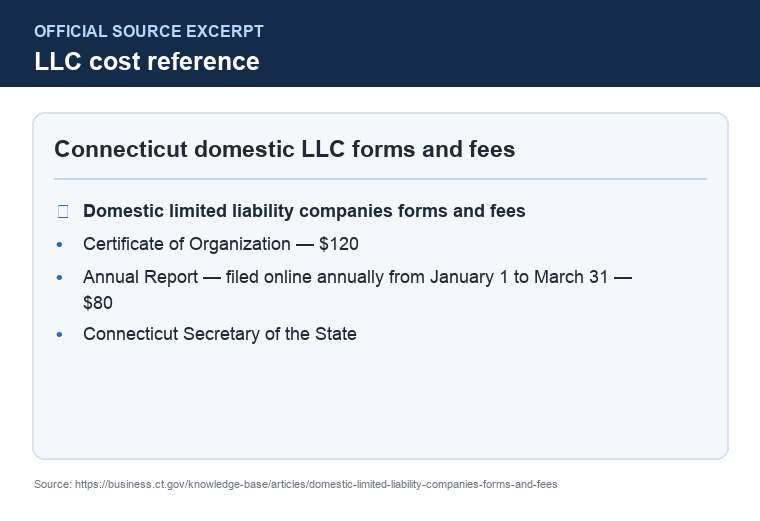
The Connecticut LLC filing fee is $120. You pay it to the Connecticut Secretary of the State through the Business.CT.gov portal. That fee stays the same whether you file online or by mail, and it covers your Certificate of Organization, the document that legally creates your LLC.
Expedited service costs an extra $50 per transaction and cuts processing time down, but it's only available for online filings. The steps themselves are covered in how to start an LLC in Connecticut.
2. Sales and Use Tax Permit ($100 - Mandatory for Most)
Selling taxable goods, renting property, or running a hotel or lodging business all trigger one requirement. You need a Sales and Use Tax Permit from the Department of Revenue Services, paid once through the state's myconneCT system.
The permit then renews on its own every two years. There's no charge, as long as your filings stay up to date. Skip this step and you can't legally make a taxable sale in Connecticut.
3. Name Reservation ($60 - Optional)
Reserving your LLC name ahead of filing costs $60. You file an Application for Reservation of Name to do it. The reservation holds the name so nobody else can claim it while you finish your paperwork.
You don't have to reserve a name to form an LLC. Run a Connecticut LLC name search first either way. That way you know the name is actually free before you file anything.
4. Trade Name / DBA ($20 - Optional)
A trade name filing costs $20 in Connecticut, paid directly to the town, not the state. You'll need one if you want to do business under a name other than the one on your Certificate of Organization.
File the application with the town clerk where you primarily do business. It's a local filing, not a state one, so the fee and process both run through your town.
Ongoing Costs to Keep Your LLC in Good Standing
Once your LLC exists, a short list of recurring costs keeps it active and compliant, starting with the one that applies regardless of how much money the business makes. For a wider comparison, see the full breakdown of LLC costs by state, or get expert help from the best LLC formation services in Connecticut.
1. Annual Report ($80 - Mandatory)
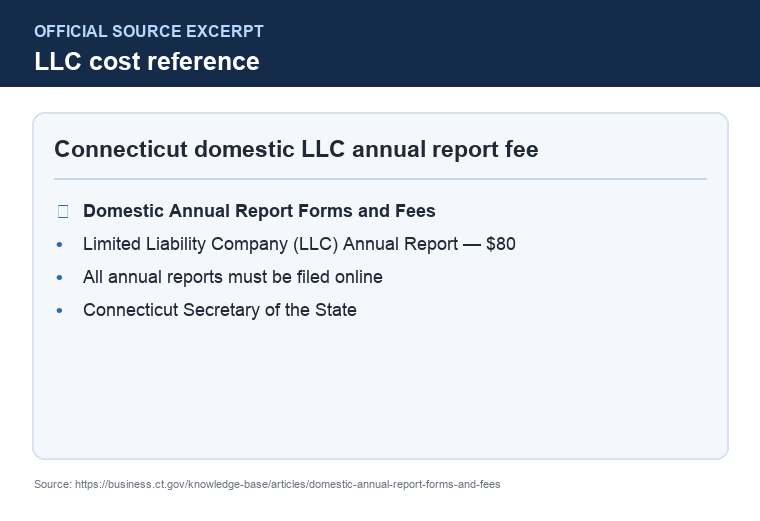
Connecticut LLCs file an Annual Report every year. The window runs from January 1 to March 31, and it costs $80. The state only accepts this filing online through Business.CT.gov. Paper submissions get rejected outright.
Missing the window doesn't just cost you money. Go more than a year without filing, and the Secretary of the State can administratively dissolve your LLC. Mark the date, and file early rather than close to the deadline.
2. State Income Tax (Depends on How You're Taxed - Mandatory)
By default, a Connecticut LLC is a pass-through entity. Profits flow to your personal return. The state taxes that income at graduated rates, which run from 2% on the lowest bracket up to 6.99% at the top.
Elect corporate tax treatment instead, and the LLC pays Connecticut's Corporation Business Tax directly. That's a flat 7.5% on net income [1]. A 10% surtax also applies, but only to companies reporting $100 million or more in federal taxable income under the state's current surtax authorization. A typical small LLC will never see it.
Optional Costs Worth Knowing About
A few more costs come up only in specific situations, closing with the one filing that should never cost you a dime.
1. Registered Agent Service ($80-$300 Annually - Optional)
Every Connecticut LLC needs a registered agent. This person or company accepts legal papers on the LLC's behalf. Acting as your own agent, or naming another LLC member, costs nothing.
Hiring a paid Connecticut registered agent service instead typically runs $80 to $300 a year. New owners often start with a paid service for the first year. Then they switch to self-representation once they know the compliance calendar.
2. Operating Agreement ($100-$300 - Optional, but Recommended)
An operating agreement spells out your LLC's ownership shares, management structure, and how profits get split. Connecticut doesn't require one. But skipping it leaves those questions unsettled if a dispute ever comes up between members.
Writing one yourself costs nothing. A formation service will draft one for roughly $100 to $300. An attorney-drafted version costs more, but it suits an LLC with several owners or detailed buyout terms.
3. Certificate of Good Standing ($50 - Optional, but Recommended)
A Certificate of Good Standing confirms your LLC is current on its filings. Connecticut also calls it a Certificate of Legal Existence. The express and short-form versions both cost $50. A long-form version costs $100, and you'll mainly need it when registering your LLC in another state.
Banks often ask for this document before opening a business account. Other states usually want one too, before they'll let your LLC register there as a foreign entity.
4. Certified Document Copies ($40-$55 - Optional)
Ordering a plain copy of any document filed with the Secretary of the State costs $40 per document. A certified copy costs $55 per document. Other agencies and banks tend to ask for the certified kind.
5. EIN from the IRS ($0 - Free)
Your Employer Identification Number comes from the IRS, not the state. Applying online is free [2]. It's the number you'll need to open a business bank account, hire employees, or apply for financing.
Some formation packages charge extra to handle this step for you. Apply yourself directly on IRS.gov instead. It costs nothing but a few minutes.
FAQs
What Happens If You Pay Connecticut Taxes Late?
Paying Connecticut taxes late triggers a penalty of 10% of the unpaid tax, or $50 for Corporation Business Tax, whichever is greater. Interest then adds 1% per month until you settle the balance.
What Payment Methods Does Connecticut Accept for LLC Filing Fees?
The payment methods Connecticut accepts for LLC filing fees are credit or debit cards, ACH bank transfers, and checks made payable to the Secretary of the State, whether you file online or by mail.
References:
- https://portal.ct.gov/drs/corporation-tax/tax-information
- https://www.irs.gov/businesses/small-businesses-self-employed/apply-for-an-employer-identification-number-ein-online