How Much Does an LLC Cost in Tennessee? (Fees Breakdown)

Forming a Tennessee LLC starts with a filing fee that most other states charge as a flat number. Tennessee charges $50 per member instead, with a $300 floor and a $3,000 ceiling, so a single-member LLC still pays the same $300 minimum as a six-member one.
That per-member structure follows the LLC every year after formation too. The Annual Report carries the identical $50-per-member fee, $300 minimum, $3,000 maximum. On top of that, Tennessee is one of the few states that taxes LLCs directly through a franchise and excise tax. A 2024 law change now shields many small LLCs from the excise-tax half of that bill.
What an owner spends beyond those two recurring items depends on the business itself. A registered agent, a business license, and a handful of optional filings round out the full picture. The breakdown below sorts every charge by when it comes due. One-time costs come first.
Quick Summary
- Tennessee's LLC fees scale with membership count instead of using a flat state rate. That per-member structure is the single fact to budget around.
- Small LLCs with modest profit can now skip the excise-tax side of the bill entirely, thanks to a 2024 deduction.
- Missing the Annual Report deadline risks administrative dissolution rather than just a fixed late fee.
| Cost Item | Amount | Frequency | Required? |
|---|---|---|---|
| Articles of Organization | $300-$3,000 ($50/member) | One-time | Yes |
| Registered Agent Service | $0 self / $80-$300 hired | Every year | Yes (self-serve allowed) |
| Name Reservation | $20 | One-time, optional | No |
| Assumed Name | $20 | One-time, renewable every 5 years | No |
| Business License | $0-$15 minimal / $15 + $22 min. tax standard | Every year | If receipts over $3,000 |
| Annual Report | $300-$3,000 ($50/member) | Every year, by April 1 (calendar-year LLCs) | Yes |
| Franchise and Excise Tax | $100 minimum + 6.5% excise above $50,000 net earnings | Every year | Yes |
| EIN | $0 | One-time | Yes for multi-member, if applicable for single-member |
| Operating Agreement | $0-$200+ | One-time | No |
Cost to Start an LLC in Tennessee
Getting a Tennessee LLC on the books takes one mandatory filing and one standing requirement. A third item only matters if the owner wants a name locked down before filing.
1. LLC Formation Filing Fee ($300-$3,000 Per-Member - Mandatory)
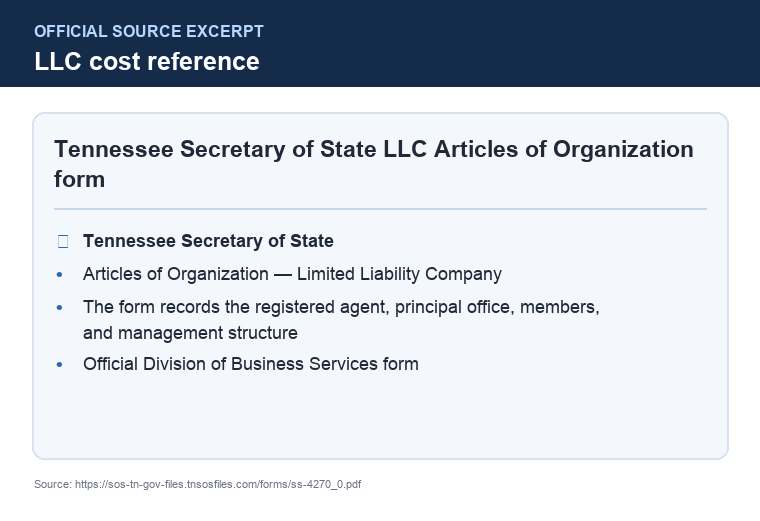
A Tennessee LLC forms by submitting Articles of Organization to the Tennessee Secretary of State. The fee is $50 per member on the filing date, with a $300 minimum and a $3,000 maximum.
Six members or fewer works out to the $300 floor, since six times $50 lands exactly there. Every member past six adds another $50, up to the cap at 60 members.
There's no expedited filing tier for an extra fee. Processing time depends on current volume at the Secretary of State's office, so check the live filing portal for the exact turnaround before submitting.
2. Registered Agent Service ($0 Self / $80-$300 Hired - Mandatory to Have, Optional to Hire)
Every Tennessee entity except a general partnership must keep a registered agent on file. That agent needs a physical Tennessee address at all times. Legal paperwork and official state notices get delivered there.
Naming yourself or another member costs nothing. The address just needs to be a genuine Tennessee street address rather than a P.O. box. Businesses that would rather keep a home address off the public record often pay a Tennessee registered agent service between $80 and $300 a year.
3. Name Reservation ($20 - Optional)
Reserving an LLC name ahead of filing costs $20. That hold lasts four months. Check the name is free first through the Secretary of State's own name search, or use the Tennessee LLC lookup tool for the same search. The hold itself doesn't run that check.
Skipping this step is fine too. Filing the Articles of Organization checks name availability at no extra charge. Owners who later want to rename the LLC can review the Tennessee LLC name change process separately.
4. Assumed Name ($20 - Optional)
Tennessee doesn't use the term "DBA." Operating under a name other than the LLC's own registered name instead takes an assumed-name filing, a separate $20 filing from the name reservation above. The assumed name stays valid for five years and can be renewed before it expires.
Expenses Following the Approval of Your LLC
Formation is only the entry fee. A separate set of ongoing and situational costs kicks in once the state approves the filing, and most of those repeat every year. The same one-time-versus-recurring pattern shows up across the full LLC cost guide for every state.
1. Business License (Depends on Gross Receipts - Mandatory Above $3,000)
Tennessee ties the business license fee to gross receipts, not to industry. An LLC earning under $3,000 a year doesn't need one at all. A $15 minimal-activity license is still available if wanted.
Receipts between $3,000 and $99,999 require that same $15 minimal-activity license. It renews annually, with no separate business tax return to file. Receipts of $100,000 or more move the LLC to a standard license instead: a $15 issuance fee plus a minimum $22 business tax owed each year [1].
County clerks issue these licenses locally. City officials do too, where the city imposes its own business tax. Contact the local clerk's office to confirm which tier applies before opening.
2. Annual Report Fee ($300-$3,000 Per-Member - Mandatory)
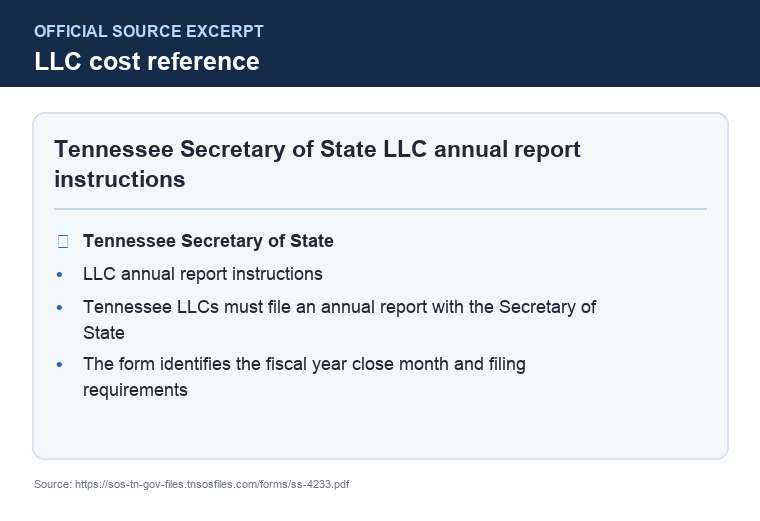
The Annual Report keeps the LLC's address and management details current with the Secretary of State. The fee structure matches formation exactly: $300 minimum, $50 per member beyond six, up to $3,000. It's due every year on the first day of the fourth month after the LLC's fiscal year closes, April 1st for a calendar-year business.
Filing happens online through the Secretary of State's business services portal. There's no fixed late fee published for a missed deadline.
Skipping it is still risky, though. Failure to file can get the LLC dissolved by the state. Getting it back active costs a separate filing on top of the report itself.
3. Franchise and Excise Taxes (Often Just $100 - Mandatory)
Tennessee taxes LLCs through two combined taxes most other states skip entirely. The franchise tax runs 0.25% of the LLC's net worth [2]. There's a $100 minimum owed every year, active or not. The excise tax runs 6.5% of net earnings, but a 2024 law now subtracts a $50,000 standard deduction from net earnings first.
That deduction means an LLC with $50,000 or less in net earnings owes $0 in excise tax. It still pays the $100 franchise-tax minimum. Larger LLCs pay 6.5% on whatever net earnings remain above the $50,000 deduction. File both taxes together through the Tennessee Department of Revenue's online portal well before the deadline to avoid penalties.
4. EIN ($0 - Required for Multi-Member LLCs, Recommended for Others)
Multi-member LLCs need an EIN no matter what. A single-member LLC can use the owner's Social Security number instead. That works until a bank account, employee, or loan application makes an EIN necessary anyway.
Either way, the IRS issues an EIN free of charge in minutes online. No formation service should charge extra just to request one on an owner's behalf.
5. Operating Agreement ($0-$200+ - Optional but Recommended)
Nothing in Tennessee law requires filing an operating agreement with the state. Skipping one leaves management structure, profit splits, and voting rules undecided on paper.
A free single-member operating agreement template, linked in the cost table above, covers the basics for a solo owner. Multi-member LLCs generally need something more thorough. Hiring an attorney or buying a template through a formation service typically runs $100 to $200.
FAQs
What Payment Methods Can I Use to Pay Tennessee's LLC Filing Fees?
Payment methods for Tennessee LLC filing fees include check, money order, debit card, or credit card. Online filings through the Secretary of State's portal take a card payment directly, while mailed paperwork needs a check or money order attached.
What Is the Penalty for Filing Taxes Late in Tennessee?
The penalty for filing state taxes late in Tennessee is 5% of the unpaid amount for each month the return is overdue, up to a maximum of 25%, plus interest accruing from the original due date.
Do I Need to Collect Sales Tax for My Tennessee LLC?
Yes, a Tennessee LLC that sells taxable goods or services does need to collect sales tax after registering for a permit. The state rate is 7%, plus up to 2.75% in local tax depending on the city or county.
Does the 2024 Excise Tax Change Apply to Every Tennessee LLC?
No, every Tennessee LLC must still file the annual franchise and excise tax return even when the $50,000 deduction brings the excise tax owed down to $0. Filing stays mandatory regardless of how much tax ends up due.
References:
- https://law.justia.com/codes/tennessee/title-67/chapter-4/part-7/section-67-4-723/
- https://law.justia.com/codes/tennessee/title-67/chapter-4/part-21/section-67-4-2106/