How to Start an LLC in Maryland (2026)

Maryland's Articles of Organization form your LLC once the State Department of Assessments and Taxation's Charter Division accepts it. The filing costs $100, whether you file online or by mail. Every LLC also owes a $300 Annual Report and Personal Property Return each year, even if the business had no income.
This guide covers forming a new, domestic Maryland LLC from scratch. If you already run an LLC in another state and want to do business here too, see the FAQ on registering a foreign LLC instead.
Quick Summary
- Check your LLC name with SDAT before you file. A rejected filing still costs you the review time.
- A member or manager can serve as your resident agent. That person's home address then becomes part of the public record.
- File the Annual Report and Personal Property Return every year. SDAT sets the deadline at April 15.
Maryland LLC Requirements at a Glance
This table pulls together the fee, the filing agency and every deadline your Maryland LLC has to meet. Use it as a quick-reference checklist before you file anything.
| LLC requirement | State-specific answer |
|---|---|
| Filing document | Articles of Organization |
| Filing authority | State Department of Assessments and Taxation (SDAT), Charter Division |
| State filing fee | $100 online or by mail |
| Online filing | Yes, Maryland Business Express |
| Processing time | Online/mail non-expedited: 6-8 weeks. Expedited (+$50): 7-10 business days. Same-day rush: +$325 online or +$425 at the drop box |
| Registered agent | Any Maryland resident 18 or older, or a Maryland corporation or LLC, with a real Maryland street address (no P.O. box) |
| Annual report | Required every year: Form 1 Annual Report, bundled with the Personal Property Return, due April 15, $300 fee for a domestic or foreign LLC |
| Publication required? | No. Maryland does not require an LLC to publish formation notice in a newspaper |
| State business tax | No franchise or privilege tax on LLCs. Income passes through to members' Maryland returns |
| Last verified | September 3, 2026 |
How to Start an LLC in Maryland: 5 Steps
Forming a Maryland LLC takes five steps. You start by picking a name and end by getting your EIN. Follow them in order, because later steps depend on facts you lock in earlier.
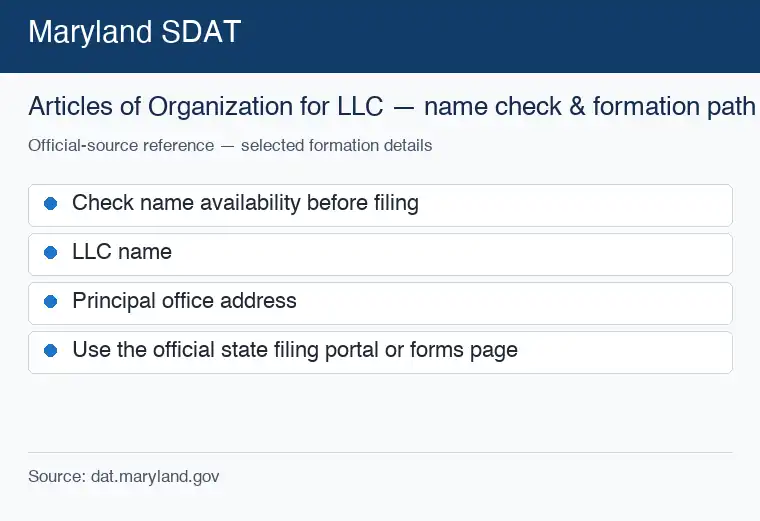
Step 1: Choose and check your LLC name
Your name needs one of five endings: Limited Liability Company, L.L.C., LLC, L.C. or L C. It also can't look too much like another business name already on file with SDAT.
Use our guide to look up an LLC in Maryland to check availability first. If you'd rather lock a name in early, SDAT will hold it for 30 days for $25, plus $20 more for rush service.
Step 2: Appoint a registered agent
In Maryland, a registered agent is called a resident agent. Any Maryland resident who is 18 or older can serve. So can a Maryland corporation or LLC.
The agent needs a real street address in the state, and must sign your Articles of Organization. A P.O. box doesn't count.
Hiring a registered agent service in Maryland keeps your home address off the public record if you'd rather not list your own.
Step 3: File the Articles of Organization with the SDAT Charter Division
File online through Maryland Business Express, or mail your papers to SDAT's Charter Division. The cost is the same either way [1].
The next section walks through what the form asks for, how to pay and how long approval takes. If you'd rather hand the paperwork off instead, compare LLC formation services in Maryland first.
Step 4: Create an operating agreement
Maryland doesn't require an LLC to have an operating agreement. If you write one, it doesn't need to be in writing at all unless your Articles of Organization say otherwise [2].
Skip one, and Maryland's LLC Act supplies default rules for how the company runs and how profits get split. Most multi-member LLCs still write one down anyway, since a verbal agreement is hard to enforce once members disagree.
Step 5: Get an EIN
Apply for a free EIN directly at irs.gov. The online tool issues your number in the same session once the application is approved. You'll need it again when you register with the Comptroller of Maryland for state tax accounts.
Filing the Articles of Organization in Maryland: What to Expect
1. What the form asks for
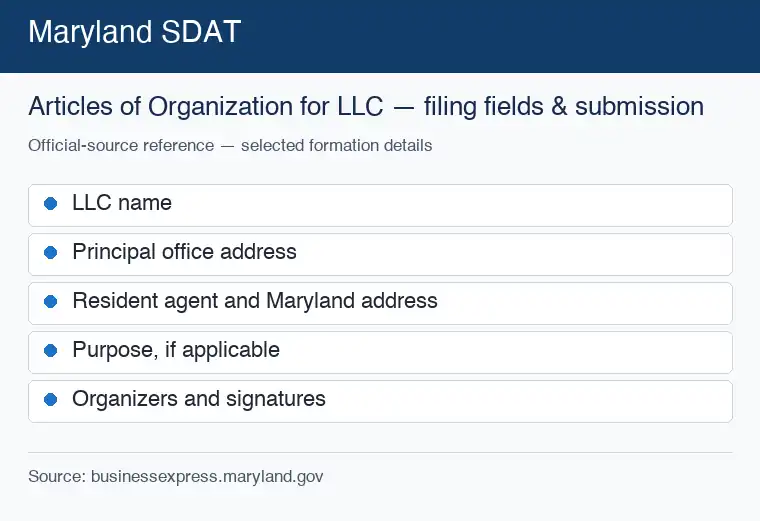
The Articles of Organization ask for seven things. You give your LLC's exact name and a one or two sentence description of what the business does. You also give the LLC's Maryland address, which can't be a P.O. box.
Next, you name your resident agent and give that agent's Maryland address. The person forming the LLC signs the form, and so does the resident agent. Finally, you list a return address so SDAT knows where to mail your confirmation.
SDAT's own instructions call this list the mandatory provisions. You may add any other provision the members want on record.
2. Fee and payment methods
You pay the same filing fee whether you mail your Articles of Organization or file online. Filing by mail costs only the fee itself, paid by check or money order made out to SDAT.
Filing online through Maryland Business Express adds a service charge on top. It's a flat $3 for an eCheck, or 3% of the total for a card or PayPal payment.
3. Processing times
Standard review of a mailed or online filing takes 6 to 8 weeks. Paying an extra $50 moves your filing into the expedited lane, which SDAT reviews in 7 to 10 business days.
For same-day review, pay $325 online, or $425 if you hand-deliver your filing to SDAT's drop box. For a closer look at each timeline, see how long it takes to form an LLC in Maryland.
| Filing method | Processing time |
|---|---|
| Online | 6-8 weeks non-expedited, or 7-10 business days if the $50 expedited fee is paid |
| Same 6-8 week non-expedited review, or 7-10 business days with the $50 expedited fee | |
| In person | Same-day review for documents hand-delivered to SDAT's drop box at 301 W. Preston Street, Baltimore, for an additional $425 |
| Expedited | 7-10 business days for $50, or same-day for $325 online or $425 at the drop box |
| Current state estimate | Not published. SDAT's Articles of Organization instructions and businesses landing page carry no current-backlog notice, and the dedicated processing-times page was unreachable when checked |
4. Where to file by mail or in person
Mail your Articles of Organization to the State Department of Assessments and Taxation, Charter Division, 301 W. Preston Street, Room 801, Baltimore, Maryland 21201-2395.
SDAT also keeps a drop box in the building lobby at 301 W. Preston Street in Baltimore. It takes both regular and same-day, in-person filings.
5. Common reasons filings are rejected
SDAT doesn't publish a specific list of common rejection reasons. Its own Charter and Legal FAQ says only one thing: the Charter Division must reject a filing, even a pre-cleared one, the moment it finds an error. It pays to double check your name, address and signatures before you send the form in.
6. What you receive when it is approved
Once SDAT finishes processing your filing, it mails a confirmation letter with your LLC's new Department ID printed on it. Buy a $20 Certificate of Status, and the same Department ID appears there too. Keep that confirmation letter with your LLC's records. It's the proof of filing SDAT sends automatically.
What It Costs to Start an LLC in Maryland
The table below lists every fee SDAT charges to form and keep a Maryland LLC running, from the one-time filing fee to the report you file every year after.
| Cost item | Amount |
|---|---|
| State filing fee | $100 online or by mail |
| Name reservation | $25 for a 30-day reservation, plus $20 for expedited service |
| Registered agent | $0 when a member, manager or other qualifying Maryland resident serves. The state does not publish a commercial resident-agent fee |
| Certified copy | $20 plus $1.00 per page |
| Expedited filing | 7-10 business day expedited review: $50. Same-day rush: $325 online or $425 at the SDAT drop box |
| Annual report | Required every year: Form 1 Annual Report, bundled with the Personal Property Return, due April 15, $300 fee for a domestic or foreign LLC |
| Other mandatory state fees | None from SDAT. A county Trader's License ($15-$800, or $2,125 in Baltimore City) may apply if you sell goods |
The filing fee and the Annual Report are mandatory. Everything else is optional: name reservation, certified copies, expedited processing. You only pay for those if you choose to use them, and for a full breakdown across every provider, see how much an LLC costs in Maryland.
Maryland-Specific Rules That Change the Process
1. Naming rules and restricted words
Step 1 covers the basic naming rules. On top of those, words like bank or trust company need a sign-off from the Office of Financial Regulation before SDAT will register the name [3].
2. No separate professional LLC statute
Maryland doesn't have a professional LLC form. The LLC Act already covers licensed occupations like architects, attorneys, accountants, physicians and engineers, so they can form an ordinary LLC [4]. Some choose a professional corporation, association or LLP instead, depending on what their licensing board prefers.
3. Members and managers stay off the public filing
The Articles of Organization never ask for your members' or managers' names. The Annual Report only asks whether the LLC is a single-member entity owned by family members. Only a corporate officer or principal signs that report, instead of every owner listing their name.
4. Foreign LLC registration
An LLC formed in another state has to register with SDAT before doing business in Maryland. You file an Application for Registration as a Foreign Limited Liability Company [5].
Name a Maryland resident agent, and attach proof of good standing from your home state. The registration fee matches a new domestic filing.
5. Business license system
Maryland has no single statewide business license that covers every LLC. If your LLC sells or disposes of goods, you need a Trader's License instead.
Get it from the Clerk of the Circuit Court in your county. The price depends on how much inventory you carry rather than your revenue [6]. The Comptroller's Combined Registration covers your general tax accounts instead.
6. Reinstatement and late filing
Miss your Annual Report or Personal Property Return, and Maryland can forfeit your LLC's charter. A forfeited LLC can no longer legally operate in the state.
Getting reinstated means filing every report you missed, paying the penalties and filing Articles of Reinstatement with SDAT. If you'd rather close the business than reinstate it, see our guide on how to dissolve an LLC in Maryland.
What to Do After Your Maryland LLC Is Approved
Your Maryland LLC needs a few more things in place before you start operating, on top of the general steps in our guide to starting an LLC.
Open a business bank account once you have your filed Articles of Organization, your EIN and the Department ID from SDAT's confirmation letter. Banks typically ask for all three. Keeping business money separate from personal money protects the liability shield your LLC gives you.
Check whether your LLC needs a Trader's License from your county's Clerk of the Circuit Court. You only need one if you sell or dispose of goods. The fee scales with how much inventory you hold rather than your income.
Register with the Comptroller of Maryland if you'll collect sales tax, withhold employee wages or want to elect the Pass-Through Entity tax. Your federal EIN comes first, since the Comptroller's registration asks for it. See filing LLC taxes in Maryland for the account-by-account breakdown. Set up basic bookkeeping from day one, too, so your Annual Report and tax returns are easy to prepare.
Keep your resident agent information current with SDAT. If your agent ever moves or resigns, update it right away using our guide on changing a registered agent in Maryland. The table below lays out the full compliance calendar.
| Compliance item | Deadline, fee and department |
|---|---|
| Initial report | None required. Maryland has no separate initial report or initial list beyond the first Annual Report/Personal Property Return, due the following April 15 |
| Annual or biennial report | Form 1 Annual Report/Personal Property Return, due April 15 every year, $300 fee, filed with SDAT |
| State tax registration | Comptroller of Maryland Combined Registration covers sales and use tax and employer withholding. LLCs may also elect the Pass-Through Entity tax |
| Renewal deadline | Not applicable at the state level for most LLCs. A county Trader's License, where required, renews annually through the Clerk of the Circuit Court |
| Late fee | An initial penalty of 1/10 of 1% of the county assessment, plus interest at 2% of that penalty amount for each 30 days (or part of one) the Annual Report is late. Continued non-filing forfeits the Maryland charter |
| Responsible state department | State Department of Assessments and Taxation (Annual Report/Personal Property Return) and Comptroller of Maryland (tax accounts) |
FAQs
Do Maryland LLCs Have to Publish a Formation Notice?
No, Maryland LLCs don't have to publish a formation notice in a newspaper. Filing the Articles of Organization with SDAT's Charter Division is enough on its own.
How Often Do I Need to File Maryland's Annual Report?
You need to file Maryland's Annual Report every year, along with a $300 fee paid to SDAT.
Will Maryland Tax My LLC's Profits Directly?
No, Maryland won't tax your LLC's profits directly. It has no separate franchise or privilege tax on LLCs, so profits pass through to the members' state returns instead.
How Do I Register an Out-of-State LLC in Maryland?
You register an out-of-state LLC in Maryland by filing SDAT's foreign LLC application before you start doing business here.
References:
- https://egov.maryland.gov/BusinessExpress/Payment/FeesSchedule
- https://mgaleg.maryland.gov/mgawebsite/Laws/StatuteText?article=gca§ion=4A-402
- https://labor.md.gov/finance/banks/use-of-name.shtml
- https://mgaleg.maryland.gov/mgawebsite/Laws/StatuteText?article=gca§ion=4A-101
- https://mgaleg.maryland.gov/mgawebsite/Laws/StatuteText?article=gca§ion=4A-1002
- https://www.marylandcomptroller.gov/businesses/new-business/license-faq.html