How to Dissolve an LLC in Colorado (2026)

Colorado LLCs close by filing a Statement of Dissolution with the Secretary of State for $10. The form only exists online, the state posts it to the record in real time, and you don't need a notary or a tax clearance certificate to file it.
This page is for LLC members who are voluntarily choosing to close a domestic Colorado LLC. A foreign LLC that only registered to do business here withdraws through a different form, covered in the FAQ below.
Quick Summary
- Settle debts and taxes before you file. Colorado doesn't require a clearance certificate, but skipping this step can leave members on the hook.
- This filing only happens online. There's no paper option, so have your entity ID and address ready before you start.
- Save proof that your LLC is officially closed. Banks and creditors may ask to see it long after you file.
Colorado LLC Dissolution Quick Reference
Here's the fee, the filing method and the requirements for closing a Colorado LLC at a glance, taken straight from the Secretary of State's own form and fee schedule.
| Detail | Information |
|---|---|
| Form name | Statement of Dissolution |
| Filing fee | $10.00 |
| Expedited options | Not applicable. The fee schedule lists one online fee, no expedite tier |
| Standard processing | Real time. The filing posts to the record immediately after payment |
| Online portal | Colorado SOS Business Organizations online filing system |
| Mail address | Not applicable. No paper filing is accepted for this form |
| In-person address | Not applicable. No paper filing is accepted for this form |
| Notarization required | No |
| Tax clearance required | No |
| Online filing mandatory for | All Colorado LLCs. No paper alternative exists |
| Short-form eligibility | Not applicable. One Statement of Dissolution form covers every Colorado LLC |
How to dissolve an LLC in Colorado: 6 steps
The state won't process your Statement of Dissolution until you handle these steps first. Colorado has its own forms and deadlines, but the process follows the same six-step framework used to dissolve an LLC in any state.
Step 1: Vote to dissolve
Check your operating agreement first. It usually sets your LLC's own dissolution vote. If it's silent, Colorado's default rule kicks in: every member has to agree before you can dissolve [1].
Step 2: Notify creditors
Colorado doesn't require you to notify creditors before you dissolve. Doing it anyway protects you from claims that show up years later.
Send a known creditor a direct notice and it starts a clock. They get at least two years to sue before their claim is barred [2].
You won't know about every creditor, though. For those, publish a notice once in a newspaper covering your LLC's home county. That starts a five-year bar, or four months after a claim arises, whichever comes later [3].
Step 3: File final tax returns
Settle your state accounts before you file to close your LLC cleanly. File your final state income tax return and mark it final. Then close your sales tax and withholding accounts.
You can close your sales tax account through Colorado's Revenue Online portal, where the closure takes effect the next business day.
You can also mail the paper Business Account Closure Form, though it takes longer to process. Submit either one within 30 days of your last day of business.
Step 4: File the Statement of Dissolution with the Colorado Secretary of State
File the Statement of Dissolution with the Colorado Secretary of State. It only exists as an online form, with no short or simplified version. Search your LLC's record on the Secretary of State's business site, open the filing option and complete it there.
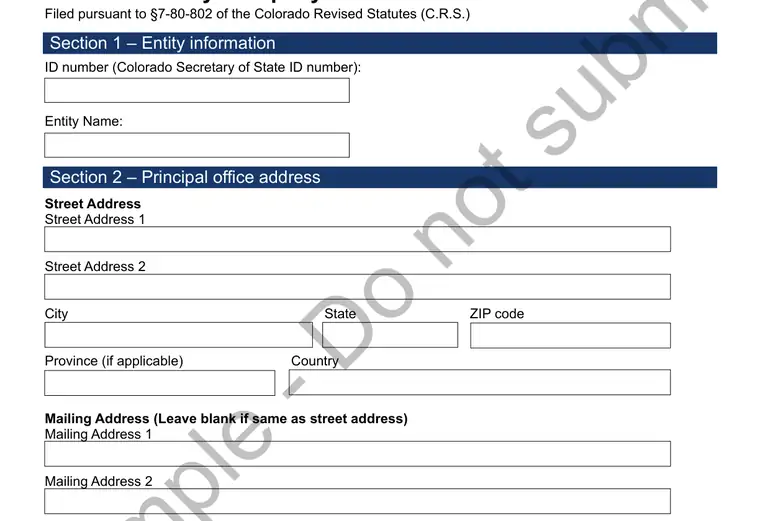
The form asks for your principal office address, whether you're attaching extra pages, and the name of at least one person causing the filing on the LLC's behalf.
Submit payment, and the state processes it in real time. No notary and no mailed copy are needed, and you can print a confirmation once the filing goes through.
Step 5: Distribute remaining assets
Before anyone gets paid, the LLC has to collect its assets and sell off what it isn't distributing in kind. It has to pay or set aside enough to cover its debts too. Only after that can members receive what's left [4].
Unless your operating agreement says otherwise, Colorado law splits what remains among members by the value of their contributions, not equally by headcount [5]. Check your LLC's own records for those contribution values before you calculate anyone's share.
Step 6: Close accounts and cancel licenses and permits
Close your LLC's bank accounts once the dissolution is filed and debts are paid. Cancel any local business licenses or permits with the city or county that issued them.
Keep a copy of your filed Statement of Dissolution. Your bank will likely ask for it before closing the account.
FAQs
How Much Does It Cost to Dissolve an LLC in Colorado?
It costs $10 to dissolve an LLC in Colorado, paid once when you file the Statement of Dissolution online through the Secretary of State. There's no separate expedite fee.
How Long Does It Take to Dissolve an LLC in Colorado?
It takes no set number of days to dissolve an LLC in Colorado. Your filing takes effect the moment your payment clears, unless you set a later effective date on the form itself.
Can I Dissolve a Foreign LLC in Colorado?
Yes, you can dissolve a foreign LLC in Colorado, though the state calls the form a Foreign Entity Authority Withdrawal instead of a dissolution, filed the same way as the domestic version.
Do Colorado LLCs Need Tax Clearance Before Dissolution?
No, Colorado LLCs don't need tax clearance before dissolution. You should still settle your income, sales and withholding tax accounts, since unresolved balances can follow members personally after the LLC closes.
References:
1. https://colorado.public.law/statutes/crs_7-80-801
2. https://colorado.public.law/statutes/crs_7-90-911
3. https://colorado.public.law/statutes/crs_7-90-912
4. https://colorado.public.law/statutes/crs_7-80-803
5. https://colorado.public.law/statutes/crs_7-80-504






My father passed away and I’m trying to locate if he had a beneficiary how do I find this?