How to File an LLC Annual Report in Texas (2026)

Texas has no annual report filed with the Secretary of State. Instead, your LLC files a yearly Franchise Tax Report with the Comptroller, due May 15. There's no separate filing fee. You only owe tax once your revenue passes the No Tax Due Threshold.
Even a $0 tax year still needs a filing. Skip it and your LLC risks losing its right to do business in Texas, even when you owe no tax.
This guide explains what the Comptroller calls this filing and how to file it online or by mail. You'll also learn what happens if you miss the deadline and how to fix a lapse.
Quick Summary
- File the Public or Ownership Information Report even with no tax due. Missing that filing threatens your LLC's right to operate in Texas.
- Keep your Texas registered agent's address current with the Secretary of State. The franchise tax filing won't fix that for you.
- Put May 15 on your calendar every year. Texas charges a penalty the day after a report is late.
Texas LLC Annual Report Quick Reference
Here's the Texas LLC franchise tax and information report at a glance, including the fee, the due date and what happens if your LLC falls behind.
| Detail | Information |
|---|---|
| Filing authority | Texas Comptroller of Public Accounts |
| Online portal | Webfile (via Comptroller eSystems) |
| Annual obligation | Franchise Tax Report plus a Public Information Report (PIR) or Ownership Information Report (OIR); Texas has no SOS-filed annual report |
| Fee | $0 filing fee; tax owed only above the No Tax Due Threshold ($2,650,000 for 2026-2027) |
| Due date | May 15 (next business day if it falls on a weekend or state holiday) |
| First report due | Same May 15 rule; no separate first-year exemption is published |
| Early filing window | Not published by the Comptroller |
| Late penalty | $50 flat penalty, plus 5% of tax due if paid 1-30 days late or 10% if paid over 30 days late; interest starts after 61 days |
| Consequence of not filing | Forfeiture of the right to transact business; officers, directors, members and owners become personally liable for certain entity debts |
| Reinstatement cost | $75 (SOS Form 801) plus a Comptroller tax clearance letter |
What the Texas LLC "Annual Report" Actually Is
Most states call this an LLC annual report. Texas splits it into two pieces instead, filed with the Comptroller rather than the Secretary of State: the Franchise Tax Report and a Public Information Report (PIR) [1].
The PIR covers corporations, LLCs and most other entities. A smaller set of entity types, ones that skip officers and directors entirely, file an Ownership Information Report (OIR) instead.
Most LLCs organized in Texas, plus most out-of-state LLCs doing business here, have to file, with the exceptions below. This holds true whether you just started an LLC in Texas this year or you've operated here for a decade.
A handful of entities skip the PIR or OIR entirely: those without Texas nexus, entities already exempt from franchise tax, qualifying new veteran-owned businesses in their first five years, and passive entities.
The same general rules described on Venture Smarter's LLC annual report overview page still apply here, just with Texas's own agency and forms.
How to File the Texas Franchise Tax Report and PIR
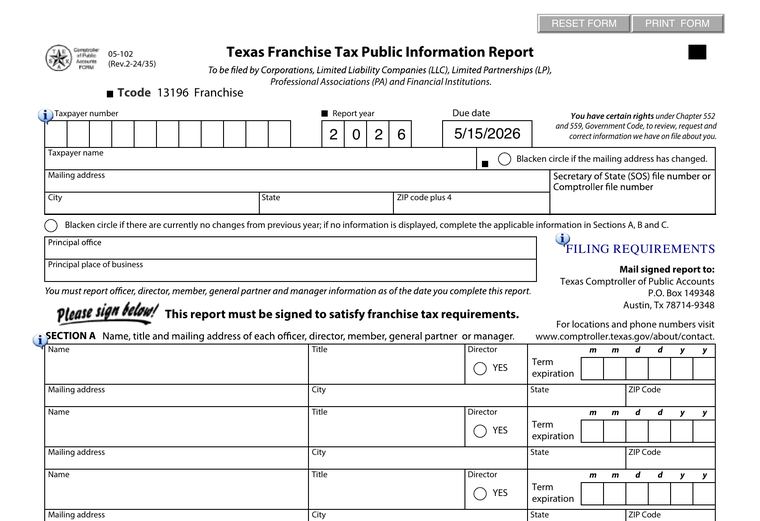
You can file the franchise tax report and the PIR or OIR online through Webfile, or send paper forms by mail. The Comptroller requires electronic filing through Webfile or EDI once your business paid $100,000 or more in franchise tax the prior year.
1. Online Through Webfile
Register for the Comptroller's eSystems portal, then log in to reach Webfile. From there you can complete both filings, the tax side and the information report, in one session.
- Log into eSystems with your Comptroller account and select Webfile.
- Enter your 11-digit taxpayer number to pull up your account.
- Complete the franchise tax report, or confirm you're at or below the No Tax Due Threshold.
- Complete the PIR or OIR, updating officer, director, member or owner information as needed, or confirming there's nothing to change.
- Submit before 11:59 p.m. Central Time on the due date.
2. By Mail
Paper filers mail the completed franchise tax report and PIR or OIR to Texas Comptroller of Public Accounts, P.O. Box 149348, Austin, TX 78714-9348. Use this same address for either form.
Due Date
The franchise tax report, your PIR or your OIR, is due May 15 every year. If May 15 falls on a weekend or a state holiday, the deadline moves to the next business day.
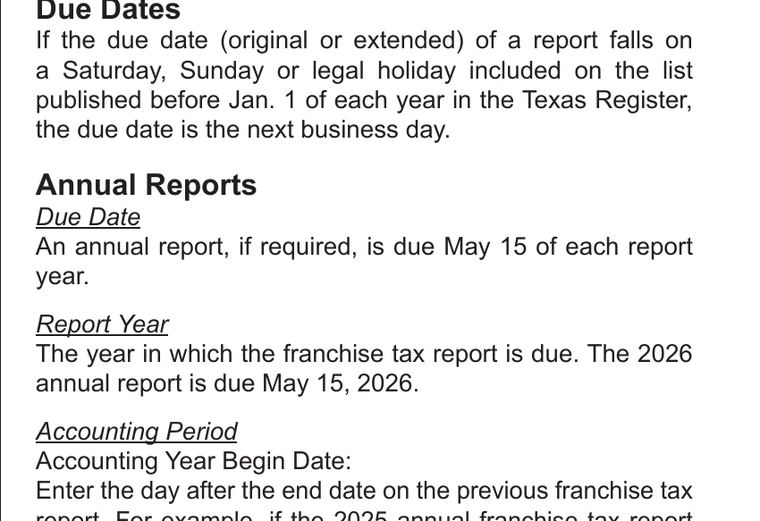
There's no separate first-year exemption. The same May 15 rule covers your LLC's first report year too. The Comptroller doesn't publish an earliest date you can file either report.
Miss the deadline and the Comptroller starts a forfeiture notice process, detailed in Penalties, Forfeiture and Reinstatement below. Filing before the notices arrive avoids the escalation entirely.
Penalties, Forfeiture and Reinstatement
Filing late costs money even before any tax comes due. A $50 flat penalty hits every report filed after May 15, whether or not you owe tax.
Add 5 percent if you pay the tax 1 to 30 days late, or 10 percent if it's later than that. Interest starts 61 days after the due date.
The PIR or OIR carries more risk than the tax bill itself. Skip that report and the Comptroller mails a Notice of Intent to Forfeit Right to Transact Business, then a Notice of Forfeiture of Registration if it goes unresolved.
A forfeited entity loses the right to sue or defend itself in a Texas court. Each officer, director, member or owner becomes personally liable for certain debts the entity runs up while forfeited [2].
Getting reinstated after a tax forfeiture means filing SOS Form 801 and paying a $75 fee [3]. You also need to clear the tax, penalty and interest that caused the forfeiture.
The Secretary of State requires a tax clearance letter from the Comptroller first, so resolve the filing before you apply.
What to Include and How to Update Information
The PIR asks for your LLC's officer, director or other authorized-person information, and it has to be completed and signed by one of them. The OIR asks the same of partners, members or owners for entities that don't use officers and directors.
Changes that happen after you file typically wait for your next annual PIR or OIR, unless the change is urgent enough to need an amendment right away.
For an error on a report you already filed, mail an amended version to the same Comptroller address, marked "Amended," with a cover letter explaining the correction. Urgent corrections can go by fax to 512-475-0433 instead of waiting on the mail.
Registered agent or registered office changes don't go through the PIR or OIR at all. File those directly with the Secretary of State, either online or on an SOS form, when you need to change your Texas registered agent.
FAQs
Do New Texas LLCs File a Report in Their First Year?
No, Texas LLCs don't skip their first year of filing just because they're new. Count from your formation date to find which report year applies, then file by that May 15.
What Happens If I File the Franchise Tax Report but Skip the Public Information Report?
Filing the franchise tax report but skipping the Public Information Report still starts the Comptroller's forfeiture notice process: first Form 05-211, then Form 05-213 if it stays unresolved. Paying the tax doesn't substitute for filing the PIR.
Do Combined Groups File One PIR or Several?
No, combined groups don't file just one PIR or OIR. Each member organized in or with nexus in Texas must file its own separate report.
References:
1. https://comptroller.texas.gov/taxes/franchise/pir-oir-filing-req.php
2. https://statutes.capitol.texas.gov/Docs/TX/htm/TX.171.htm
3. https://direct.sos.state.tx.us/help/help-corp.asp?pg=fee





Hey there fantastic blog! Does running a blog similar