How to Dissolve an LLC in Massachusetts (2026)

To dissolve an LLC in Massachusetts, you file a Certificate of Cancellation. You send it to the Secretary of the Commonwealth, Corporations Division. The fee is $100. The state won't take your filing until your annual reports and fees are current.
This page is for LLC owners who choose to close a domestic Massachusetts LLC on their own. If your LLC formed in another state, you'll file a different form instead. It's called a Certificate of Withdrawal.
Quick Summary
- Confirm who can wind up the LLC. Massachusetts law gives that job to a manager, or the members if there's none.
- Close your tax accounts before you file the cancellation. Otherwise, Massachusetts DOR keeps billing a company that no longer operates.
- Keep a copy of the filed certificate. You'll need it to close the LLC's bank accounts and cancel local licenses.
Massachusetts LLC Dissolution Quick Reference
Here's what to know before you file. Check the fee. Check the mailing address. See whether notarization or a tax clearance certificate applies.
| Detail | Information |
|---|---|
| Form name | Certificate of Cancellation |
| Filing fee | $100 |
| Expedited options | +$10 for expedited processing |
| Standard processing | Not officially published; commonly about 3-5 business days by mail, 1-2 business days in person |
| Online portal | Corporations Online Filing System (requires the LLC's CID and PIN) |
| Mail address | Secretary of the Commonwealth, Corporations Division, One Ashburton Place, 17th Floor, Boston, MA 02108 |
| In-person address | One Ashburton Place, 17th Floor, Boston, MA 02108 |
| Notarization required | No |
| Tax clearance required (agency) | No. Close tax accounts through MassTaxConnect (Dept. of Revenue) instead |
| Online filing mandatory for | None. Filing online is optional statewide |
| Short-form eligibility | Not applicable. One Certificate of Cancellation covers all domestic LLCs |
How to dissolve an LLC in Massachusetts: 6 steps
Follow these six steps in order. They're part of the general process to dissolve an LLC, though the details are different in each state.
Step 1: Vote to Dissolve
Look at your operating agreement before you file anything, and start there instead of guessing. If the agreement is silent, Massachusetts law has a default rule. Every member must give written consent [1]. Record that vote in writing.
Step 2: Notify Creditors
Once members agree to dissolve, notify creditors in writing. Massachusetts law requires a dissolved LLC to pay known claims. Or it must set money aside for them [2]. That includes claims it can reasonably spot. Even if no one has come forward yet.
State law doesn't set an exact deadline for creditors to respond. Use your operating agreement as a guide, or pick a reasonable deadline and write it down.
Send notices to lenders, vendors and any landlord your LLC still owes money to. Keep proof you sent each notice.
Step 3: File Final Tax Returns and Close Your Tax Accounts
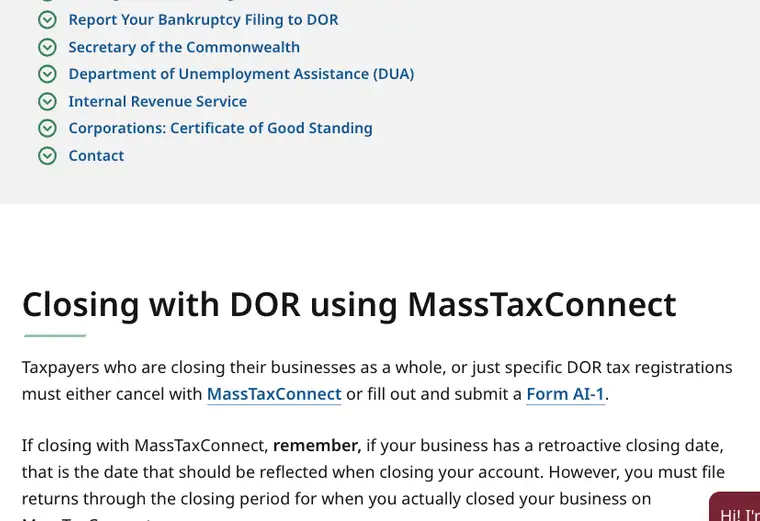
File a final Massachusetts tax return for the LLC, then close its state tax accounts. Use MassTaxConnect, the Department of Revenue's online tool.
Massachusetts skips a separate tax clearance step [3]. You don't need one before you file the Certificate of Cancellation. Corporations used to need something similar, but not LLCs.
Just keep your Massachusetts annual reports current, and pay any fees you owe the Corporations Division. The cancellation rule blocks your filing until that's settled [4].
Step 4: File the Certificate of Cancellation
File the Certificate of Cancellation with the Corporations Division by mail, in person or online. Online filing needs the LLC's CID and PIN. Expedited handling adds $10 to the $100 base fee. Processing starts once the Corporations Division gets your paperwork.
Massachusetts doesn't offer a short-form or simplified version of this filing. Every domestic LLC uses the same Certificate of Cancellation, regardless of size or debts.
The certificate must list a few things. Include the LLC's federal EIN. Include its name, its organization date and the reason for cancellation. Want a later effective date? Add one. No notary is required.
Step 5: Distribute Remaining Assets
Massachusetts law sets the order for what's left. Creditors get paid first, including any member or manager the LLC owes money to.
After creditors, members get distributions they're already owed. Whatever remains goes back as a return of contributions. Then it splits by ownership share. Put the numbers in writing so every member can see the math.
Step 6: Close Accounts and Cancel Licenses and Permits
Bring your filed certificate to the LLC's bank before you close the account. Confirm every check has cleared, and confirm every automatic payment has stopped too.
Contact each lender or card issuer directly to close credit lines tied to the LLC. Ask for written confirmation once each one is closed.
Cancel local licenses and permits with the city or town that issued them, so you don't keep paying renewal fees for a business that's gone. Paid for a registered agent service in Massachusetts? Cancel it once the state confirms your cancellation is filed.
Planning to start a new LLC in Massachusetts later? Our guide on how to start an LLC in Massachusetts walks through setup from scratch. Compare the best LLC services first if you want help with the paperwork.
FAQs
How Long Does It Take to Dissolve an LLC in Massachusetts?
It takes 3 to 5 business days to dissolve an LLC in Massachusetts by mail, or 1 to 2 business days in person. The state doesn't publish a set turnaround for either method.
How Much Does It Cost to Dissolve an LLC in Massachusetts?
It costs $100 to dissolve an LLC in Massachusetts, the filing fee for a Certificate of Cancellation. Expedited processing adds $10 to that fee.
Do Foreign LLCs File the Same Cancellation Form in Massachusetts?
No, foreign LLCs don't file the same cancellation form in Massachusetts. They withdraw by filing a Certificate of Withdrawal instead of the domestic Certificate of Cancellation.
References:
- https://malegislature.gov/Laws/GeneralLaws/PartI/TitleXXII/Chapter156C/Section43
- https://malegislature.gov/Laws/GeneralLaws/PartI/TitleXXII/Chapter156C/Section46
- https://www.mass.gov/info-details/closing-your-massachusetts-business-registration
- https://www.law.cornell.edu/regulations/massachusetts/950-CMR-112-19