How to File LLC Taxes in North Carolina (2026)

If you run a single-member LLC in North Carolina, you report your share of profit on Form D-400 and pay North Carolina's 3.99% personal income tax rate. Multi-member LLCs file Form D-403 instead and pay the same rate on their share.
Either structure can elect S-corp or C-corp tax treatment using Form CD-401S or Form CD-405. All four forms go to the North Carolina Department of Revenue.
This page walks through the state form for each LLC type, North Carolina's current income tax rate, the pass-through entity election, and the other state taxes an LLC owner needs to track this year.
Quick Summary
- Income tax goes to the NCDOR instead of the Secretary of State. Confirm your current tax year's rate on ncdor.gov before you file.
- A default LLC doesn't owe North Carolina's corporate franchise tax. That only kicks in if you elect S-corp or C-corp status.
- Talk to a CPA before you elect PTET or S-corp status. Only a CPA can confirm the savings are worth the extra paperwork.
North Carolina LLC Tax Summary
Here's how the federal and state forms line up for each North Carolina LLC type, so you can see what you owe and where it goes.
| LLC Type | Federal Form | State Form | Filed With | Filing Deadline & Tax Rate |
|---|---|---|---|---|
| Single-member LLC | Form 1040 (Schedule C) | Form D-400 | NCDOR | April 15, 3.99% (2026) |
| Multi-member LLC | Form 1065 | Form D-403 | NCDOR | April 15, members pay 3.99% |
| S-Corp election | Form 1120-S | Form CD-401S | NCDOR | April 15, franchise tax $200 minimum |
| C-Corp election | Form 1120 | Form CD-405 | NCDOR | April 15, 2.00% income tax plus franchise tax |
How North Carolina LLCs are taxed
The IRS treats every LLC as a pass-through entity by default, and North Carolina follows that same default for state income tax.
Profit passes through to the owners, who report it on their own returns instead of the LLC paying tax directly.
An LLC can also elect S-corp or C-corp treatment with the IRS, and North Carolina taxes the LLC according to whichever federal election is on file.
For the full federal-level breakdown of how LLC taxes work across every state, see our main guide. If you haven't formed your LLC yet, our guide to start an LLC in North Carolina covers that first step.
You'll also need a registered agent on file before the state accepts any of these returns. Line one up through our registered agent services in North Carolina guide if you haven't already.
1. Single-member LLC, Form D-400
A single-member LLC is a disregarded entity by default, so the IRS taxes it like a sole proprietorship. You report business profit on your personal federal return and again on your North Carolina individual return, Form D-400, filed with the NCDOR.
2. Multi-member LLC, Form D-403
A multi-member LLC defaults to partnership taxation. The LLC files a federal partnership return and sends each owner a Schedule K-1 showing their share of profit.
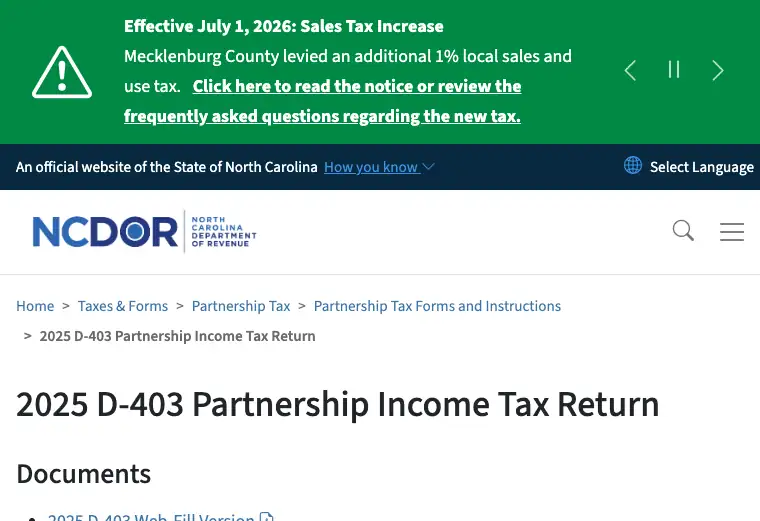
On the state side, the LLC files Form D-403, the North Carolina Partnership Income Tax Return, with the NCDOR. Each partner then reports their K-1 share on their own Form D-400.
3. S-Corp election, Form CD-401S
An LLC can ask the IRS to tax it as an S-corp instead. Members become employees who take a salary, and only that salary is subject to federal self-employment tax. The rest of the profit passes through as a distribution.
On the state return, an S-corp files Form CD-401S with the NCDOR. The election also puts the entity inside North Carolina's corporate franchise tax system, which the C-corp section below explains in full.
4. C-Corp election, Form CD-405
C-corp status is the least common election because the corporation pays tax on its profit, then shareholders pay tax again on dividends. Some owners still choose it to attract investors or access certain corporate deductions.
A C-corp files Form CD-405 with the NCDOR and pays North Carolina's 2.00% corporate income tax on top of the federal corporate rate.
Electing C-corp or S-corp status triggers North Carolina's corporate franchise tax on top of income tax, a tax a default LLC never owes.
For a C-corp, the franchise tax is capped at $500 for the first $1,000,000 of the corporation's tax base, then $1.50 per $1,000 above that, with a $200 minimum.
An S-corp pays a flat $200 on the first $1,000,000 of its tax base, then $1.50 per $1,000 above that, also with a $200 minimum.
North Carolina income tax rate for tax year 2026
North Carolina's individual income tax rate for tax year 2026 is 3.99%. That's the rate single-member LLC owners, partners and PTET-electing S-corp and partnership owners pay on their share of profit [1].
The rate has stepped down each of the past several years, so confirm it on the NCDOR schedule before you file rather than trusting an old number.
Federal taxes North Carolina LLC owners pay
Every LLC owner who isn't taxed as an S-corp pays federal self-employment tax on their share of profit. The rate is 15.3%, covering 12.4% for Social Security and 2.9% for Medicare [2].
North Carolina doesn't add a separate state self-employment tax on top of that. LLC owners still owe quarterly estimated tax, both federal and state, once their expected tax bill clears a set threshold.
The federal and North Carolina due dates line up: April 15, June 15 and September 15 of the tax year, then January 15 of the following year.
On the state side, you owe estimated tax once your North Carolina liability is expected to hit $1,000. You pay it with Form NC-40.
Other North Carolina taxes that may apply
Depending on what your LLC sells and whether it has employees, a few more North Carolina taxes can apply on top of income tax.

1. Sales and use tax
If your LLC sells taxable goods or services in North Carolina, register with the NCDOR before you collect a dime, using Form NC-BR to receive a Certificate of Registration. North Carolina's general state rate is 4.75%.
Most counties add a 2.00% or 2.25% local rate on top, and four counties add a separate 0.50% transit rate, so most areas land between 6.75% and 7.00% total [3].
2. Local taxes
Some cities and counties layer extra local taxes on specific goods and services beyond the standard state sales tax rate, and these add-ons vary by location.
Check with the tax office in every city or county where your LLC does business, beyond just where it's registered.
3. Employer taxes
If your LLC has employees, you'll deal with two separate state agencies. Register with the NCDOR using Form NC-BR, then withhold state income tax from every paycheck.
Remit withholding with Form NC-5 for monthly or quarterly filers, or Form NC-5Q for semiweekly filers, and reconcile the year with Form NC-3.
Unemployment insurance tax is a separate system, run by the NC Division of Employment Security instead of the NCDOR. New employers start at a 1.000% rate on the 2026 taxable wage base of $34,200.
After your first couple of years, your rate is recalculated based on your claims history and can range from 0.06% to 5.76% [4].
4. Excise and industry taxes
Some industries owe North Carolina excise or privilege taxes on top of everything above. Alcohol, tobacco, motor fuels and a handful of other specific industries each have their own tax schedule through the NCDOR.
If your LLC operates in one of these industries, check the NCDOR's industry-specific tax pages before you set your prices.
North Carolina pass-through entity tax (PTET) election
Eligible S-corps and partnerships, including multi-member LLCs taxed as partnerships, can elect to pay North Carolina income tax at the entity level instead of passing it through to owners. This is the pass-through entity tax, or PTET, election.
It exists because federal law caps how much state and local tax an individual can deduct. Paying the tax at the entity level sidesteps that cap since the LLC deducts it as a business expense instead [5].
The entity pays tax on its North Carolina income at the same rate individuals pay. You make the election by checking the box on a timely filed NC Tax Return, including any valid extension.
You can't make the election once the return is late. Once you elect, estimated payments follow the same schedule as a C-corp once your expected liability hits $500.
What is deductible for a North Carolina LLC
A Taxed S-corp or Taxed Partnership can deduct the North Carolina income tax it pays at the entity level as a business expense on its federal return, which is the entire point of the PTET election.
Beyond that, North Carolina LLCs follow ordinary federal business-expense rules for deductions like supplies, payroll and business use of a vehicle.
The federal qualified business income deduction under Section 199A is a federal deduction rather than a North Carolina one, so it doesn't reduce what you owe the NCDOR.
FAQs
Do LLCs Pay Taxes in North Carolina?
Yes, LLCs pay taxes in North Carolina, though the entity itself usually doesn't write the check. Profit passes through to the owners, who pay North Carolina's 3.99% individual income tax rate on their personal return unless the LLC elected S-corp or C-corp status.
What Tax Forms Does an LLC File in North Carolina?
The tax forms an LLC files in North Carolina depend on its structure. Single-member LLCs use Form D-400, multi-member LLCs use Form D-403 and LLCs that elect corporate status use Form CD-401S or CD-405, all due April 15 for calendar-year filers.
Do Foreign LLCs Registered in North Carolina Need to Pay North Carolina Taxes?
Yes, foreign LLCs registered in North Carolina need to pay North Carolina taxes once they have nexus in the state, the same as a domestic LLC, including income tax and potentially sales, withholding and unemployment tax.
How Does North Carolina Tax LLCs, Directly or Only Through Members?
North Carolina taxes LLCs directly only if they elect C-corp or S-corp status, or make the PTET election. A default LLC isn't taxed directly since profit and the tax bill pass through to individual members instead.
References:
- https://www.ncdor.gov/taxes-forms/individual-income-tax/tax-rate-schedules
- https://www.irs.gov/businesses/small-businesses-self-employed/self-employment-tax-social-security-and-medicare-taxes
- https://www.ncdor.gov/taxes-forms/sales-and-use-tax/sales-and-use-tax-rates/current-sales-and-use-tax-rates
- https://www.des.nc.gov/employers/tax-rate-information
- https://www.ncdor.gov/important-notice-regarding-north-carolinas-recently-enacted-pass-through-entity-tax-2