How to File LLC Taxes in New York (2026)

A single-member New York LLC reports its income on the owner's personal return, and a multi-member LLC files Form IT-204.
Both owe New York's annual LLC filing fee once they have New York-source income to report, and an S-corp election adds Form CT-6 while a C-corp election means filing Form CT-3.
This page walks through the state form each LLC type files, the current New York tax rates and the deadlines that apply. It also covers other state-level taxes, like sales tax and employer withholding, that a New York LLC owner needs to track.
Quick Summary
- Expect two agencies. The IRS sets your federal classification, and New York's tax department handles the filing fee, franchise tax or PTET election that follows.
- Confirm this year's rate before you file. New York's tax brackets change every year.
- Get a CPA to model the S-corp or PTET election first. Both reshape your New York filing obligations in ways that are hard to unwind.
New York LLC Tax Summary
Here's the New York state form each LLC classification files, alongside the federal form it starts from, who it gets filed with and the deadline and rate that apply.
| LLC Type | Federal Form | State Form | Filed With | Filing Deadline & Tax Rate |
|---|---|---|---|---|
| Single-member LLC | Schedule C (Form 1040) | Form IT-204-LL (if it has NY-source income) | New York State Department of Taxation and Finance | March 15 (flat $25 fee) |
| Multi-member LLC | Form 1065 | Form IT-204 plus Form IT-204-LL | New York State Department of Taxation and Finance | March 15 (fee $25 to $4,500 by NY-source gross income) |
| S-Corp election | Form 1120-S | Form CT-6 election plus Form CT-3-S | New York State Department of Taxation and Finance | March 15 |
| C-Corp election | Form 1120 | Form CT-3 | New York State Department of Taxation and Finance | April 15 (6.5% to 7.25% of the business income base) |
How New York LLCs Are Taxed
New York treats an LLC as a pass-through entity by default, so the tax responsibility flows to the members instead of the LLC paying income tax as its own entity.
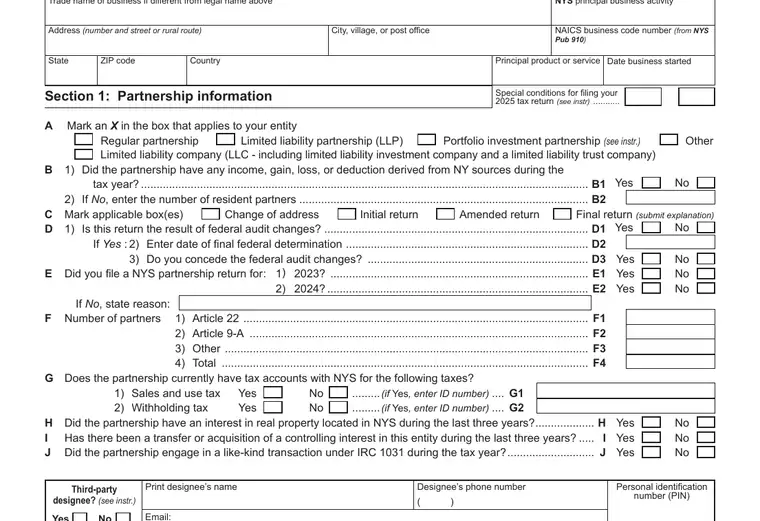
Members carry their share of that profit onto their own New York filing, and the LLC's federal classification, disregarded entity, partnership, S-corp or C-corp, decides which state form it files.
An LLC can also change how the IRS classifies it, which shifts which state form applies below. See our guide to how LLC taxes work for the federal classification rules this page builds on.
1. Single-Member LLC (Schedule C, Form 1040)
A single-member LLC pays no separate state income tax on its own. New York treats it as a disregarded entity, so the owner reports its profit and loss on Schedule C and pays New York personal income tax through their own IT-201 or IT-203 return.
Beyond what it costs to form an LLC in New York, the LLC still owes the flat $25 annual filing fee if it has any New York-source income.
That fee is due on Form IT-204-LL by March 15 if the LLC uses a calendar year, and no extension is available.
2. Multi-Member LLC (Form IT-204)
A multi-member LLC is taxed as a partnership by default, so each member reports their share of profit on their own New York return instead of the LLC paying tax directly. The LLC files federal Form 1065, then files Form IT-204 with the state.
It also owes the same annual filing fee as a single-member LLC, scaled from $25 to $4,500 by its New York-source gross income. The fee is due by March 15 for a calendar-year LLC.
3. LLCs Taxed as S-Corp (Form CT-6 and CT-3-S)
Electing S-corp status with the IRS does not make an LLC an S-corp in New York. The LLC still has to file its own Form CT-6 election with the state.
That election is due by the 15th day of the third month of the tax year the election applies to. Once it's in place, the LLC files Form CT-3-S every year.
Form CT-3-S is due within two and a half months of the tax year's close, March 15 for a calendar-year filer. Its shareholders then pay New York personal income tax on their share of the S-corp's net income.
4. LLCs Taxed as C-Corp (Form CT-3)
An LLC that elects C-corp status files federal Form 8832 with the IRS and Form 1120, due April 15 for a calendar-year filer.
New York taxes that same LLC under Article 9-A, which means filing Form CT-3, also due April 15, at the corporate franchise tax rate covered in the next section.
5. New York Income and Franchise Tax Rates for Tax Year 2025
New York's personal income tax runs from 4% on the lowest bracket up to 10.9% on income over $25,000,000, the rate schedule the state has published for tax year 2025, the most recent one released [1].
It applies to a single-member owner's Schedule C income, a multi-member member's partnership share and an S-corp shareholder's distributive share.
A C-corp LLC pays New York's Article 9-A franchise tax on its business income base instead [2]:
- Business income base: 6.5% up to $5,000,000, 7.25% above it, 0% for qualified NY manufacturers and 4.875% for qualified emerging technology companies.
- Business capital base: 0.1875%, capped at $5,000,000 in tax.
- Fixed dollar minimum tax: $25 to $200,000, scaled by New York receipts.
Federal Taxes New York LLC Owners Pay
An LLC member who isn't treated as an S-corp shareholder owes federal self-employment tax of 15.3% on their earnings, split between 12.4% for Social Security and 2.9% for Medicare [3]. New York has no separate state self-employment tax.
Members who expect to owe tax pay it quarterly through estimated payments, due April 15, June 15, September 15 and January 15 at the federal level [4]. New York collects its own estimated income tax payments on Form IT-2105.
Other New York Taxes That May Apply
Beyond income and franchise tax, a New York LLC may owe several other state taxes depending on what it sells and whether it has employees.
1. Sales and use tax
New York's state sales and use tax rate is 4%, and counties, cities and school districts can add their own local rate on top of it, so the total collected depends on where the sale happens [5].
An LLC that sells taxable goods or services has to register as a sales tax vendor and get a Certificate of Authority before it starts making sales.
2. Employer Taxes
An LLC with employees has to withhold New York state income tax from wages and register with the state Department of Labor for unemployment insurance.
For 2026, New York's UI contribution rate runs from 1.7% for the lowest-rated employers to 9.5% for the highest, with a 4.1% total rate for new employers, applied to the first $17,600 an employee earns in the year [6].
Employers must also carry workers' compensation insurance for every employee, priced by company size and the type of work those employees do day to day.
3. Industry and Local Taxes
Some New York LLCs owe an additional tax tied to their industry: cigarette and tobacco sellers, alcoholic beverage sellers and businesses that record a mortgage all pay a separate state tax on top of income and franchise tax.
Check with the state agency for your specific industry before you assume the standard rates above are the only ones that apply.
New York Pass-Through Entity Tax (PTET) Election
New York's pass-through entity tax (PTET) lets an eligible partnership or S-corp pay state tax at the entity level instead of the members paying it individually, which helps members work around the federal cap on deducting state and local taxes.
An eligible partnership or S-corp opts in online between January 1 and March 15 for that tax year. The election is irrevocable once the entity's first estimated payment is due [7].
The PTET rate is graduated by pass-through entity taxable income [8]:
- Up to $2,000,000: 6.85% of taxable income.
- $2,000,000 to $5,000,000: $137,000 plus 9.65% of the amount over $2,000,000.
- $5,000,000 to $25,000,000: $426,500 plus 10.30% of the amount over $5,000,000.
- Over $25,000,000: $2,486,500 plus 10.90% of the amount over $25,000,000.
The annual PTET return is due March 15 after the close of the PTET year, with a six-month extension available. Have a CPA model the numbers before you opt in.
What Is Deductible for a New York LLC
A New York LLC owner who itemizes deductions on their personal return files Form IT-196, which covers medical and dental expenses, charitable gifts and mortgage interest, among other itemized items.
The federal qualified business income deduction under Section 199A is a federal deduction only. It reduces what an LLC owner reports to the IRS and has no separate New York equivalent on the state return.
FAQs
Does a Single-Member LLC in New York Need to File Form IT-204-LL If It Has No New York Income?
No, a single-member New York LLC doesn't have to file Form IT-204-LL for a year in which it has no income, gain, loss or deduction from New York sources. The filing fee only applies once the LLC has New York-source activity to report.
Can a Single-Member LLC in New York Elect New York's PTET?
No, a single-member LLC can't opt into New York's PTET unless it has elected to be treated as an S-corp for New York purposes. The election is otherwise limited to eligible partnerships and S-corps.
What Happens if My Federal S-Corp Election Is Still Pending When I File New York's CT-6?
If your federal S-corp election is still pending when you file New York's CT-6, you can still submit the CT-6 and indicate that the federal election hasn't been approved yet. The state will process it alongside your federal status.
Does New York Charge a Separate Franchise Tax for LLCs That Don't Elect Corporate Status?
No, New York doesn't charge Article 9-A franchise tax on an LLC that hasn't elected corporate status. A default single-member or multi-member LLC pays the annual IT-204-LL filing fee instead, and only an S-corp or C-corp election brings it under the franchise tax.
References:
- https://www.tax.ny.gov/forms/html-instructions/2025/it/it201i-2025.htm
- https://www.tax.ny.gov/bus/ct/def_art9a.htm
- https://www.irs.gov/businesses/small-businesses-self-employed/self-employment-tax-social-security-and-medicare-taxes
- https://www.irs.gov/faqs/estimated-tax
- https://www.tax.ny.gov/pdf/publications/sales/pub718.pdf
- https://dol.ny.gov/unemployment-insurance-rate-information
- https://www.tax.ny.gov/bus/ptet/
- https://www.tax.ny.gov/e-services/ptet/calculations.htm