How to File LLC Taxes in Idaho (2026)

Idaho taxes LLC income based on how the IRS classifies your LLC. A single-member LLC reports profit on Schedule C and files the owner's Form 40.
A multi-member LLC files Form 65, and an LLC taxed as an S-corp or C-corp files Form 41S or Form 41. Every one of these returns goes to the Idaho State Tax Commission, and the state taxes all of them at a flat 5.3% rate.
This page walks through which form fits your LLC's classification. You'll also find the current rate and deadline for each, plus the Idaho taxes that apply on top of your federal return.
Quick Summary
- Match your LLC's tax classification to the right state form before you file. Each classification has its own form, due date and rate.
- Confirm this year's Idaho rate on the Tax Commission's site before you calculate what you owe. The rate has changed almost every year since 2022.
- Talk to a CPA before electing S-corp status or the pass-through entity election. Both change your deadline and what you owe.
Idaho LLC Tax Summary
Here's how Idaho taxes each LLC type, the form each one files, and where that filing goes, at a glance.
| LLC Type | Federal Form | State Form | Filed With | Filing Deadline & Tax Rate |
|---|---|---|---|---|
| Single-member LLC | Schedule C (Form 1040) | Form 40 | Idaho State Tax Commission | April 15, 5.3% flat |
| Multi-member LLC | Form 1065 | Form 65 | Idaho State Tax Commission | March 15, 5.3% at partner level + $10 PBF |
| S-Corp election | Form 1120-S | Form 41S | Idaho State Tax Commission | March 15, 5.3% at shareholder level |
| C-Corp election | Form 1120 | Form 41 | Idaho State Tax Commission | April 15, 5.3% + $20 min |
How Idaho LLCs Are Taxed
Idaho follows the federal default for LLC taxation. A single-member LLC is a disregarded entity, so the owner reports its income directly.
A multi-member LLC is taxed as a partnership, and each member reports their share on a personal return. Either type can elect corporate treatment by filing federal Form 8832, then Form 2553 for S-corp status.
Idaho follows that federal classification on its own, with no separate state filing to make. Read more in our guide on how LLC taxes work, or see our guide on starting an LLC in Idaho if you haven't formed yours yet.
1. Single-Member LLC
A single-member Idaho LLC pays no separate business-level tax on its profit. The owner simply reports profit and loss on Schedule C each year.
That figure gets attached to their personal Form 1040, and the same Idaho-source income carries onto Form 40. The return and any tax due are set for April 15 for calendar-year filers.
2. Multi-Member LLC
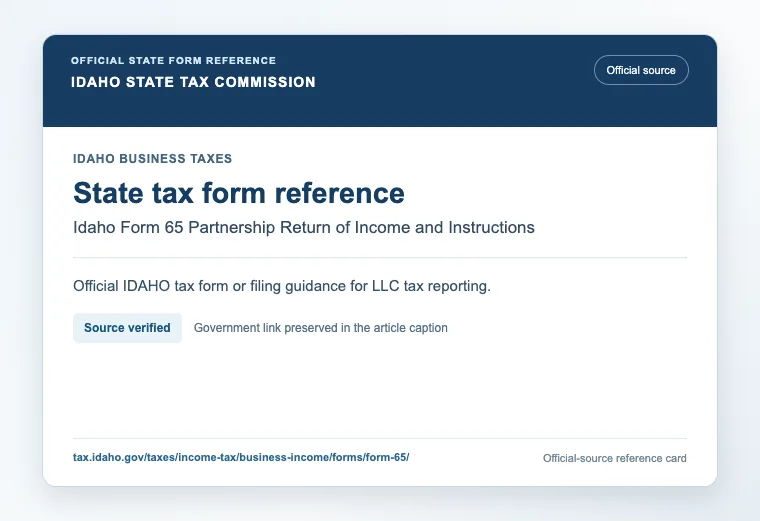
A multi-member Idaho LLC files as a partnership by default. The LLC itself files Form 1065 with the IRS and Form 65 with the state.
Each member then reports their share of the profit on a personal return. Idaho's partnership return is due March 15, with a six-month extension available through federal Form 7004.
Idaho also collects a $10 Permanent Building Fund tax from the partnership for each partner. This fee is separate from the partnership's income tax obligation described above.
3. LLC Taxed as S-Corp
An LLC that elects S-corp status still passes income through to its owners, but payroll rules change. Shareholder-employees must pay themselves a fair salary first, and that wage is subject to payroll tax.
Any profit left over passes through free of self-employment tax. The corporation files Form 1120-S federally and Form 41S with Idaho, both due March 15.
The corporation also owes a $10 Permanent Building Fund tax for each shareholder. This flat fee applies on top of the S-corp's payroll tax obligations covered above.
4. LLC Taxed as C-Corp
An LLC that elects C-corp status pays tax at the entity level, then again when profit is distributed as dividends. The corporation files Form 1120 federally and Form 41 with Idaho, both due April 15 for calendar-year filers.
The corporation also owes a $20 minimum tax and a $10 Permanent Building Fund tax on top of that. See our breakdown of the cost to form an LLC in Idaho for the full picture of what these flat fees add up to.
Idaho Income Tax Rate for 2026 Filings
Every LLC type above pays Idaho's flat 5.3% rate for the 2025 tax year, the year covered by returns filed in 2026.
The rate kicks in once taxable income passes $4,812 for single filers or $9,623 for joint filers. It has dropped every year since 2022 under a series of state rate cuts.[1]
Federal Taxes Idaho LLC Owners Pay
The IRS taxes LLC profit the same way regardless of which state you're in. If you're self-employed through your LLC, you owe federal self-employment tax on top of income tax.
Self-employment tax is 15.3% of net earnings once you clear $400, covering Social Security and Medicare. Idaho doesn't add a separate state self-employment tax.
If you expect to owe tax, both the IRS and Idaho want quarterly estimated payments due April 15, June 15, September 15 and January 15. Use Form 51 to make Idaho's estimated payments.
Other Idaho Taxes That May Apply
Beyond income tax, an Idaho LLC may owe employer, sales and other industry-specific taxes, depending entirely on what the business actually does.
Every Idaho LLC must also keep a registered agent on file. If you need to update yours, see our guide on a registered agent in Idaho.
1. Sales and Use Tax
If your LLC sells goods or taxable services in Idaho, you must collect and remit sales tax. The state rate is 6%.
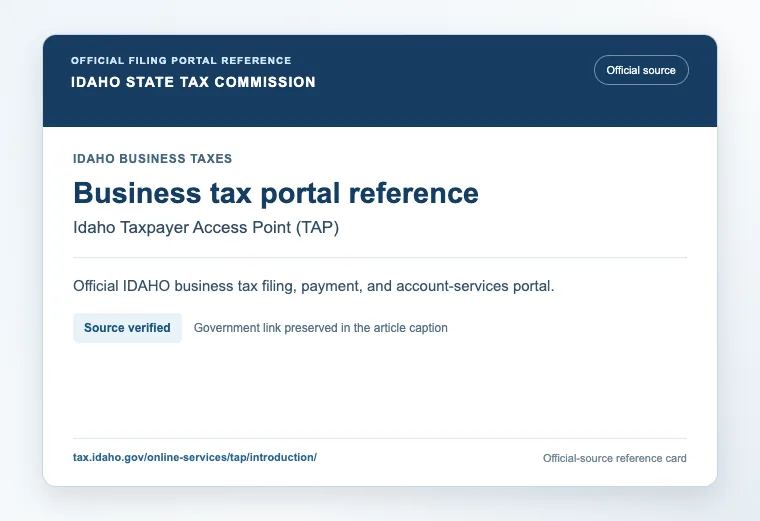
Before your first taxable sale, apply for a seller's permit through Idaho Business Registration (IBR). After your business has an active Idaho tax account, register for Taxpayer Access Point (TAP) to file and pay sales tax.
2. Unemployment Insurance Tax
If you have employees, Idaho requires unemployment insurance tax on top of the federal FUTA tax. New employers pay a standard rate of 1.000% for 2026, on the first $58,300 of each employee's wages.
The state later recalculates your rate based on your claims history. Register with the Idaho Department of Labor before you hire your first employee.
What's Deductible for an Idaho LLC
Idaho offers a handful of state-specific credits and deductions on top of whatever you claim federally. LLC owners who sell qualifying Idaho property can deduct up to 60% of the capital gain, computed on Form CG.
Idaho residents can also claim a food tax credit worth $155 per person, or up to $250 if you keep your grocery receipts. Talk to a CPA about which of these state credits fit your specific LLC structure.
Idaho Pass-Through Entity Tax (PTET) Election
Idaho's pass-through entity tax lets a partnership or S-corp pay Idaho tax at the entity level instead of passing it all to owners. The state calls this the Affected Business Entity election.
It exists because the federal SALT deduction cap makes state tax non-deductible for individual owners, but fully deductible when the entity pays it.[2]
Any partnership or S-corp can make the ABE election by checking a box on a timely filed original return. The entity must make that choice fresh every year.
Idaho taxes the ABE at the same flat rate as a C-corp, and payment is due April 15 for calendar-year filers.
FAQs
Do Foreign LLCs Doing Business in Idaho Owe Idaho Income Tax?
Yes, foreign LLCs doing business in Idaho owe Idaho income tax on their Idaho-source income, the same as a domestic LLC. If the LLC has nonresident owners, it can use Idaho's Affected Business Entity election or Form PTE-01 withholding to cover their share instead of each nonresident filing alone.
Does Idaho Charge a Separate Franchise Tax on LLCs?
No, Idaho doesn't have a standalone franchise tax on LLCs, unlike some states. C-corps and S-corps still owe the flat fees discussed above, but there's no additional franchise or privilege tax layered on top.
Can a Single-Member LLC Make Idaho's Pass-Through Entity Election?
No, only partnerships and S-corporations can make Idaho's Affected Business Entity election. A single-member LLC taxed as a disregarded entity doesn't qualify, since the statute limits the election to entities with a partner- or shareholder-level pass-through structure.
References:
- https://legislature.idaho.gov/statutesrules/idstat/Title63/T63CH30/SECT63-3025/
- https://legislature.idaho.gov/statutesrules/idstat/Title63/T63CH30/SECT63-3026B/