How to Start an LLC in Delaware (2026)

Starting a Delaware LLC means filing a Certificate of Formation with the Delaware Division of Corporations. The fee is $110. Delaware skips the annual report. It bills every LLC a flat $400 tax each year regardless of in-state business.
If you already formed an LLC somewhere else and want it to do business in Delaware too, that's a different process. It's called foreign LLC registration. We cover it in the FAQs below.
Quick Summary:
- Check your name before you pay. Search Delaware's name records first to avoid filing under a name that's already taken.
- Your registered agent's address becomes public record. Use a commercial agent if you'd rather keep your home address off the state's website.
- Mark the tax deadline on your calendar right after you file. Check the compliance calendar below so a missed payment doesn't trigger penalties.
Delaware LLC Requirements at a Glance
Here's the core information for forming and maintaining a Delaware LLC, pulled directly from the Division of Corporations' own filings and fee schedule.
| LLC requirement | State-specific answer |
|---|---|
| Filing document | Certificate of Formation of a Limited Liability Company |
| Filing authority | Delaware Division of Corporations, Department of State |
| State filing fee | $110 (same fee whether mailed or submitted through the Document Filing and Certificate Request Service) |
| Online filing | Yes, the Document Filing and Certificate Request Service, an online upload system rather than an instant self-filing wizard |
| Processing time | Not published for regular filings, which are processed in order received. Expedited service (1-hour to next-day) is available for a fee |
| Registered agent | A Delaware resident or authorized entity with a physical office in the state. Virtual offices and mail-forwarding services don't qualify |
| Annual report | None required. Delaware LLCs do not file a periodic report, and instead pay a flat $400 annual tax due each June 1 |
| Publication required? | No. Delaware does not require newspaper publication of LLC formation |
| State business tax | $400/yr flat LLC tax to Division of Corporations, not corporate franchise tax. Business license and gross-receipts tax go to Division of Revenue |
| Last verified | September 3, 2026 |
How to Start an LLC in Delaware: 5 Steps
Forming a Delaware LLC comes down to five steps. Work through them in order. You'll end up with a legally formed company ready to operate.
Step 1: Choose and check your LLC name
Your LLC's name must include "Limited Liability Company," "L.L.C." or "LLC" [1]. It also has to be different from every other business name already on file with the Division.
An exception applies if that other company files written consent to share a similar name. Search the Division's own name records before you settle on anything. Our guide on how to look up an LLC in Delaware walks through that search.
If you're not ready to file yet, you can hold your name instead. That hold lasts 120 days and costs $75 through the same online system.
Step 2: Appoint a registered agent
Every Delaware LLC needs a registered agent with a physical office in the state. That agent must be there during business hours to accept legal papers for it.
The agent can be a Delaware resident or an authorized business entity. It can't work only through a virtual office or a mail-forwarding service.
If your LLC already has a physical address in Delaware, it can act as its own agent. Otherwise, our list of registered agent services in Delaware compares your paid options.
Step 3: File the Certificate of Formation with the Division of Corporations
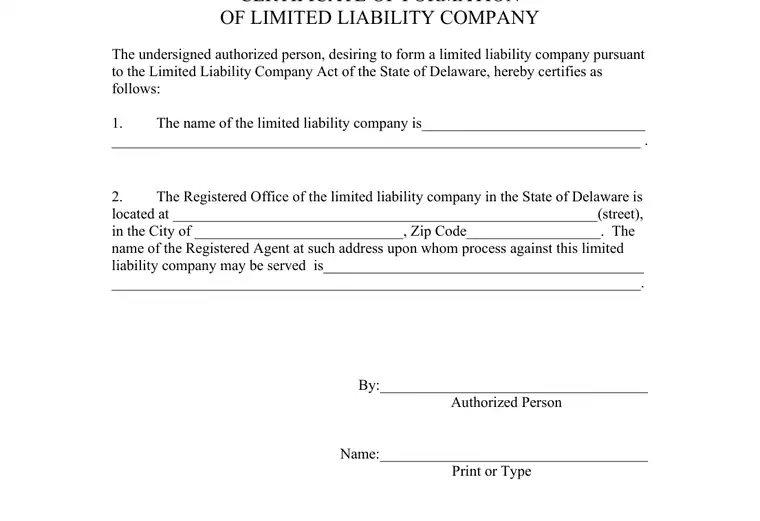
The Certificate of Formation is a short document. It names your LLC and its registered agent. You can mail it, submit it through the Division's online Document Filing and Certificate Request Service, or drop it off in person.
The next section walks through exactly what the form asks for, what it costs and how the fee gets paid. If you'd rather have someone else prepare and file it, our list of LLC formation services in Delaware compares your options.
Step 4: Create an operating agreement
Delaware doesn't require an LLC agreement to be in writing. It can be written, oral or even implied by how the members act. It still binds everyone involved, even in a single-member LLC.
Without one, Delaware's default LLC Act rules decide how the company runs. Those rules also decide who can sign on its behalf and what happens if a member leaves. The default rules rarely match how a specific business operates.
Step 5: Get an EIN
You can get an EIN for free at irs.gov. The number is issued right away once your online application clears. Banks, payroll providers and most federal tax filings all ask for it, so request one as soon as your Certificate of Formation comes back stamped.
Filing the Certificate of Formation in Delaware: What to Expect
This is the most detailed part of forming a Delaware LLC. It covers exactly what the state asks for and what happens after you send your paperwork in.
1. What the form asks for
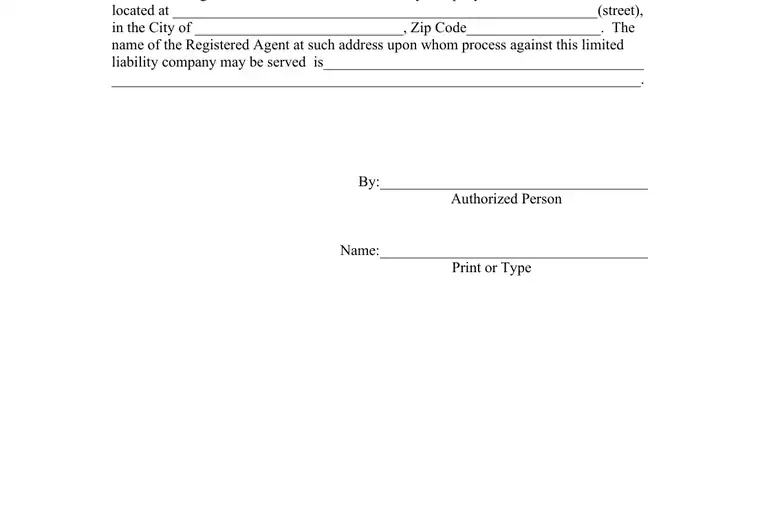
The Certificate of Formation is short by design. It asks for only two things. It wants the LLC's exact name, plus the name and Delaware street address of its registered agent. An authorized person signs and prints their name at the bottom.
Delaware doesn't ask for a principal business address. It doesn't ask for a stated purpose, a management structure or a duration either.
2. Fee and payment methods
The filing fee is $110. You can pay it by mail, online or in person. If you file online through the Document Filing and Certificate Request Service, you can pay by card, including American Express, Discover, MasterCard or Visa.
Mailed and walk-in filings need a check instead. Make it payable to "Delaware Secretary of State," drawn on a U.S. bank. The Division doesn't accept credit cards for those two channels.
3. Processing times
Delaware doesn't publish a fixed turnaround for regular filings. Instead, the Division processes work in the order it arrives, and callers can ask which date they're currently working on.
That lets you decide whether to pay for faster service. If timing matters, our page on how long it takes to form an LLC in Delaware breaks down each expedited tier.
| Filing method | Processing time |
|---|---|
| Online | No fixed turnaround published. Uploads through the Document Filing and Certificate Request Service enter the same regular/expedited queue as mail |
| No fixed turnaround published. Processed in the order received based on office volume | |
| In person | Check only, with no separate published turnaround. Same options apply, and help is by appointment only |
| Expedited | 1-Hour $1,000 (by 9pm), 2-Hour $500 (by 7pm), Same Day $100-$200 (by 2pm), Next Day $50-$100 (by 7pm) |
| Current state estimate | Not published as a dated notice. The Division advises callers to ask which date is currently being processed before choosing expedited service |
4. Where to file by mail or in person
Mail regular filings to Division of Corporations, PO Box 898, Dover, DE 19903. For express mail or in-person drop-off, use Division of Corporations, John G. Townsend Building, 401 Federal Street, Suite 4, Dover, DE 19901. In-person help with your paperwork is by appointment only.
5. Common reasons filings are rejected
Delaware never spells out specific reasons a Certificate of Formation gets bounced back. Its one published standard is simple. A submission only gets filed once it arrives in proper form with the full fee already attached.
6. What you receive when it is approved
Once your Certificate of Formation is filed, you get back a stamped "Filed" copy of the document. The Division returns it by regular first-class mail. Provide a FedEx or UPS account number if you want faster delivery instead.
What It Costs to Start an LLC in Delaware
Filing the Certificate of Formation is the only cost every Delaware LLC has to pay. Everything else on this list is optional. It's priced by the vendor you choose or tied to a specific request you make.
| Cost item | Amount |
|---|---|
| State filing fee | $110 (same fee whether mailed or submitted through the Document Filing and Certificate Request Service) |
| Name reservation | $75, holds the name for 120 days |
| Registered agent | $0 if a Delaware resident member or manager serves with a street address here. The state does not publish a commercial-agent price |
| Certified copy | $50 per certified copy |
| Expedited filing | 1-Hour Service $1,000, 2-Hour Service $500, Same Day Service $100-$200, Next Day Service $50-$100, per document/request |
| Annual report | None required. Delaware LLCs do not file a periodic report, and instead pay a flat $400 annual tax due each June 1 |
| Other mandatory state fees | There is no other mandatory fee besides the $110 filing fee and the $400 annual LLC tax |
Name reservation, certified copies and expedited service are all optional. A paid registered agent sets its own price, since the state doesn't publish one. Our breakdown of what it costs to form an LLC in Delaware compares typical spending across these options.
Delaware-Specific Rules That Change the Process
A few Delaware-specific rules shape how the process plays out. They cover what your name can include and what happens if you skip the state's yearly tax.
1. Naming restrictions and restricted words
Beyond needing "LLC" in the name, you can't use the word "bank" or a variation of it. An exception applies if the company is a supervised bank, savings association or bank holding company.
Words like "Company," "Association," "Club," "Foundation," "Fund," "Institute," "Society," "Union," "Syndicate," "Limited," "Public Benefit" or "Trust" are all allowed as extras.
2. Professional LLC rules
Delaware's LLC Act has no separate chapter for professional LLCs. A licensed professional forms a standard Delaware LLC instead. They also follow whatever rules their own licensing board sets, through the Division of Professional Regulation.
3. Member and manager disclosure
The Certificate of Formation names only your LLC and its registered agent. Members and managers who own or run the company never show up in that public record.
4. Foreign LLC registration
An LLC formed in another state needs a foreign registration to do business in Delaware. It files an Application for Registration as a Foreign Limited Liability Company with the Division of Corporations.
The fee is $200 [2]. A certified copy costs another $50. It also needs a Delaware registered agent, the same as a domestic LLC.
5. The annual tax and what happens if you miss it
The compliance calendar below has the exact due date. Missing it adds a $200 penalty plus interest at 1.5% a month, no matter the LLC's income or activity.
Three straight years of unpaid tax gets your certificate of formation canceled. Reviving it afterward costs a $180 filing fee, on top of the back taxes and penalties.
If you'd rather close the company than pay all of that, dissolving might make more sense. See our guide on how to dissolve an LLC in Delaware.
What to Do After Your Delaware LLC Is Approved
Once the state approves your Delaware LLC, a handful of tasks turn the paperwork into a working business. Our broader guide to starting an LLC walks through the same tasks for any state.
1. Banking
A bank will ask to see your stamped Certificate of Formation and your EIN. It wants both before it opens an account under the LLC's name.
2. Licenses and permits
Any LLC doing business in Delaware needs a state business license from the Division of Revenue. You apply for it through the One Stop system.
Certain professions need an extra license from the Division of Professional Regulation. Your city or county may add its own local license too.
3. Tax accounts
Register with the Division of Revenue for any gross-receipts or withholding tax accounts your business needs. That's separate from the yearly tax you pay to the Division of Corporations. Our page on filing LLC taxes in Delaware covers what each account involves.
4. Ongoing compliance
Put the dates below on a calendar. That way, the yearly tax and any license renewal never sneak up on you.
| Compliance item | Deadline, fee and department |
|---|---|
| Initial report | None required |
| Annual or biennial report | None. No periodic report is filed, and a flat $400 annual LLC tax is due each June 1 to the Division of Corporations |
| State tax registration | You register with the Division of Revenue's One Stop system for a business license and any gross-receipts or withholding tax accounts |
| Renewal deadline | The business license expires on December 31 each year and can be renewed online. A 3-year license costs 3 times the annual fee |
| Late fee | There is a $200 flat penalty plus 1.5% interest each month on unpaid tax. After three years unpaid, the certificate of formation is canceled |
| Responsible state department | Division of Corporations (Delaware Department of State). Division of Revenue (Delaware Department of Finance) |
FAQs
Does the Owner's Name Become Public When You Form an LLC in Delaware?
No, Delaware doesn't publish the owner's name when you form an LLC. Only the company's name and its registered agent's information appear in the state's filing system, keeping members and managers out of the public record.
Is an Annual Report Required for a Delaware LLC?
No, an annual report isn't required for a Delaware LLC. The state replaces it with a flat yearly tax that every domestic and foreign LLC owes to the Division of Corporations, with no financial details or member information to report.
Does Delaware Charge a Franchise Tax on LLCs?
No, franchise tax in Delaware is a corporation-only charge. LLCs never get a franchise tax bill, since the annual LLC tax already covers them instead.
Can I Be My Own Registered Agent in Delaware?
Yes, you can be your own registered agent in Delaware as long as your LLC keeps a physical office here that's staffed during normal business hours to receive legal papers. Without a Delaware office, you'll need to name an individual or company that has one.
Does Delaware Require an Operating Agreement?
No, Delaware doesn't require an operating agreement, and the one you have doesn't even need to be written down. A spoken or implied agreement among members still counts.
Does Delaware Require LLCs to Publish a Notice?
No, Delaware doesn't require LLCs to publish a formation notice in a newspaper. Delaware's process ends once the Division of Corporations files your certificate.
References:
- https://delcode.delaware.gov/title6/c018/sc01/index.html
- https://delcode.delaware.gov/title6/c018/sc09/index.html