How to Change Your Registered Agent in Colorado (2026)

To change your registered agent in Colorado, file the Statement of Change form. File it online with the Colorado Secretary of State. The fee is $10. Bundle it into your entity's annual Periodic Report instead and pay $25.
Colorado law uses the term registered agent for this job. The Secretary of State's Business Organizations Division handles the filing. There's no mail-in or in-person option for this change. Everything runs through the state's online business-filing system.
Since July 1, 2025, Colorado also checks the new agent's identity. That happens before it accepts the filing, and the step is covered below.
Quick Summary
- Filing the Statement of Change online is the fastest path. You can also bundle the update into your annual Periodic Report instead.
- Since July 1, 2025, individual agents need a Colorado ID number on the filing. A passcode works if they don't have one.
- The new agent must consent. You must also confirm notice reached your business before Colorado will accept the filing.
| Item | Detail |
|---|---|
| Form | Statement of Change Changing the Registered Agent Information |
| Filing fee | $10 (or $25 if bundled into your Periodic Report) |
| Filing channel | Online only, Colorado Secretary of State business site |
| New agent consent | Required (checkbox on the form) |
| Notice to your entity | Required (checkbox on the form) |
| ID verification (since July 1, 2025) | Colorado driver's license/ID number, or an agent passcode |
| Filing agency | Colorado Secretary of State, Business Organizations Division, 1700 Broadway, Suite 550, Denver, CO 80290 |
Who Can Be a Colorado Registered Agent
Colorado lets you pick an individual or a business entity as your agent. Either one must meet the state's rules [1]:
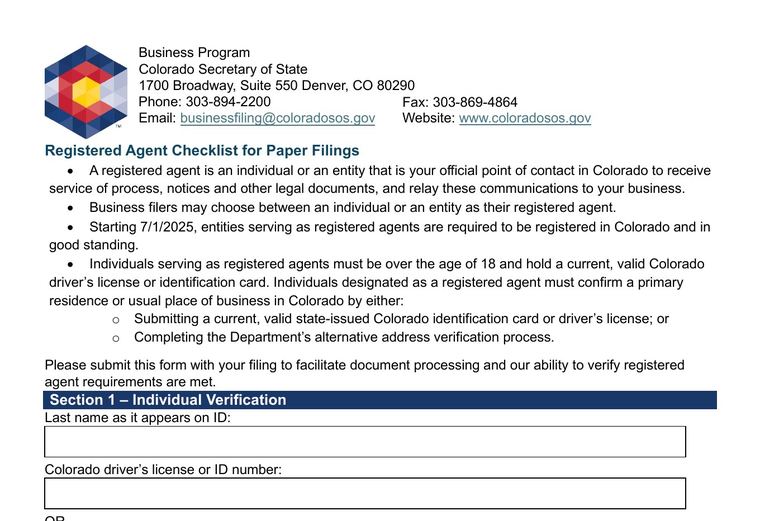
- Individual: 18 or older. Living in Colorado, or keeping a usual place of business there. Holding a current Colorado driver's license or ID card, or completing the state's alternative address-verification process instead.
- Business entity: Registered with the Secretary of State and in good standing. A usual place of business in the state. Foreign entities also need authority to do business in Colorado.
Whoever you pick needs a physical Colorado street address. That address must stay open during normal business hours. P.O. boxes don't qualify there. A separate mailing address can be a P.O. box, as long as it's also in Colorado [2].
An entity with a usual place of business in Colorado can even act as its own agent. That takes two filings. First, appoint someone else. Then file a change naming the entity itself.
The agent's job stays narrow. Forwarding service of process and other legal or state paperwork is the whole assignment. Filing your taxes or other compliance work isn't part of it.
Skipping a registered agent puts your entity at real risk. A lawsuit can be served another way, one you never see coming. Your good standing can lapse. The state can mark your entity Delinquent.
Since July 1, 2025, Colorado asks filers to enter the agent's driver's license or ID number. That number must match the one printed on the card. This comes from a fraud-prevention law the legislature passed [3].
Without a Colorado ID, the agent can request a passcode instead. The state mails it, and it stays good for 45 days.
Naming yourself as your own agent puts your address on the public record. That's why many owners compare the best registered agent services instead. It beats listing a home or office address.
How to Change Your Colorado Registered Agent
Once your new agent is lined up, you have two direct ways to notify the Colorado Secretary of State. A professional-service option exists too. Use it if you'd rather skip the filing yourself.
The steps below cover Colorado. For the process in every state, see our national guide on changing your registered agent.
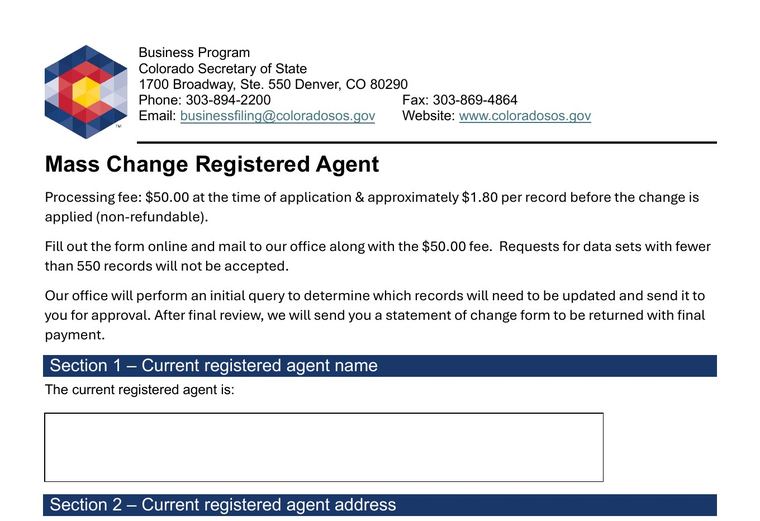
Colorado also runs a bulk registered agent update service. It's built for agent companies with 550 or more entities at once. The cost: a $50 fee, plus about $1.80 per record.
That's a tool built for big providers. It fits companies managing many entities at once. A typical owner doesn't need it for one agent change.
1. Filing the Statement of Change Online
Log into your account on the Secretary of State's business site. Open the "Business Forms List" from your entity's page. Select "Changes."
Then choose the Statement of Change Changing the Registered Agent Information. This form is filed under Colorado's registered-agent statute [4].
Fill in your business entity number and name. Add the old agent's details. Then add the new agent's name and Colorado address, exactly as the form asks.
Check the box for the new agent's consent. Check a second box to confirm you told your business about the change. Colorado won't accept the filing without both boxes marked.
If the new agent is a person, enter their Colorado driver's license or ID number. Type it exactly. Match the card. Without a Colorado ID, an agent passcode covers the gap. Finish the filing once it arrives.
Pay the $10 fee to submit. Colorado doesn't publish a standard turnaround time for this filing. Check your entity's Summary page to confirm the update went through once it's processed.
The change takes effect right away by default. You can delay it up to 90 days instead. Use this if you'd rather time it differently.
2. Updating Your Registered Agent With Your Periodic Report
Every reporting entity in Colorado has to file a Periodic Report. This happens every single year, without exception. That group includes LLCs and corporations alike [5].
The report lets you update your agent's name and address at the same time. The $25 report fee covers the agent update too, so there's no separate charge on top.
You can file the report up to two months before your assigned month. The same goes for two months after, with no penalty. If that window is already close, bundle the agent change into it. That saves you a separate filing.
Missing the window carries its own cost. A $50 late fee applies. Your entity also shifts to Delinquent status until you catch up.
3. Using a Professional Registered Agent Service
Hiring a professional registered agent service is the easiest path. It skips the online form entirely. Sign up, hand over your business and new-agent details, and the provider takes it from there.
A full-service provider gets its own consent on record. It files the form. Or it folds the filing into your Periodic Report instead. Then it takes over as your agent going forward.
The best registered agent services in Colorado charge their own annual fee. It sits on top of the state's cost. In exchange, they handle the paperwork and the follow-up.
Ready to Update Your Colorado Registered Agent
Owners change registered agents for plenty of reasons. An old provider resigned. A new service costs less. The business itself moved.
Whatever brought you here, Colorado's process stays short. Just line up a new agent first. Confirm they meet the eligibility rules. Get their consent on record. Then file with the Secretary of State online.
FAQs
Am I Allowed to List Myself as My Own Colorado Registered Agent?
Yes, you can list yourself as your own Colorado registered agent if you clear the same age, residency and ID rules the state sets for any individual filling that job. Your address then becomes part of the entity's public record.
What Does a Colorado Registered Agent Change Actually Cost?
A Colorado registered agent change costs $10 filed alone, or $25 if you fold it into your yearly Periodic Report instead.
How Long Does It Take to Change a Registered Agent in Colorado?
Colorado sets no fixed timeline to change a registered agent. Submit online with both required boxes checked for the smoothest path through the system.
What Happens If My Colorado Entity Has No Registered Agent?
Your Colorado entity risks a default judgment with no registered agent on file to catch the paperwork. Good standing can lapse too, and Delinquent status can follow.
References:
- https://law.justia.com/codes/colorado/title-7/corporations-and-associations/article-90/part-7/section-7-90-701/
- https://www.sos.state.co.us/pubs/business/FAQs/regAgent.html
- https://www.coloradosos.gov/pubs/business/RAchanges.html
- https://law.justia.com/codes/colorado/title-7/corporations-and-associations/article-90/part-7/section-7-90-702/
- https://law.justia.com/codes/colorado/title-7/corporations-and-associations/article-90/part-5/section-7-90-501/