How Much Does an LLC Cost in Arizona (Filing Fees Explained)

Forming an LLC in Arizona costs $50. That's the state filing fee for the Articles of Organization, paid to the Arizona Corporation Commission.
Arizona has no LLC annual report, so there's no yearly filing fee to the state itself. Most recurring costs come from your statutory agent and any licenses your company needs.
New owners also budget for Arizona's newspaper notice and an optional name reservation. Here's the full breakdown of what to expect.
Quick Summary
- Confirm your agent's county before budgeting for publication. It is the one cost item priced by a paper instead of the state.
- Price is not the only difference between agent services, since compliance alerts and response times vary by provider.
- Order a certificate of good standing only when a lender, bank or partner actually asks for one. Don't file it routinely.
| Cost Item | Amount | Frequency | Required? |
|---|---|---|---|
| Articles of Organization | $50 ($85 total with expedited processing) | One-time | Mandatory |
| Publication of Notice | $60-$120 (free if agent is in Maricopa or Pima County) | One-time | Mandatory unless exempt |
| Statutory Agent Service | $0 (self) or $80-$300 | Every year | Optional |
| Transaction Privilege Tax License | $12 per business location | Annual renewal (no state fee) | Mandatory if selling taxable goods or services |
| State Income Tax | 2.5% flat (4.9% if taxed as a corporation) | Ongoing | Mandatory |
| Name Reservation | $10 mail, $45 total online | One-time (120 days) | Optional |
| Operating Agreement | $0 (template) or $300-$2,500 (attorney) | One-time | Optional |
| DBA / Trade Name | $10 ($35 total expedited) | One-time (5-year renewal) | Optional |
| Certificate of Good Standing | $10 mail, $45 online | As needed | Optional |
| Certified Copies | $5 plus $0.50 per additional page | As needed | Optional |
| EIN | $0 | One-time | Recommended |
One-Time Formation Costs in Arizona
These are the costs you pay once to legally form the LLC. It starts with the filing that creates the company.
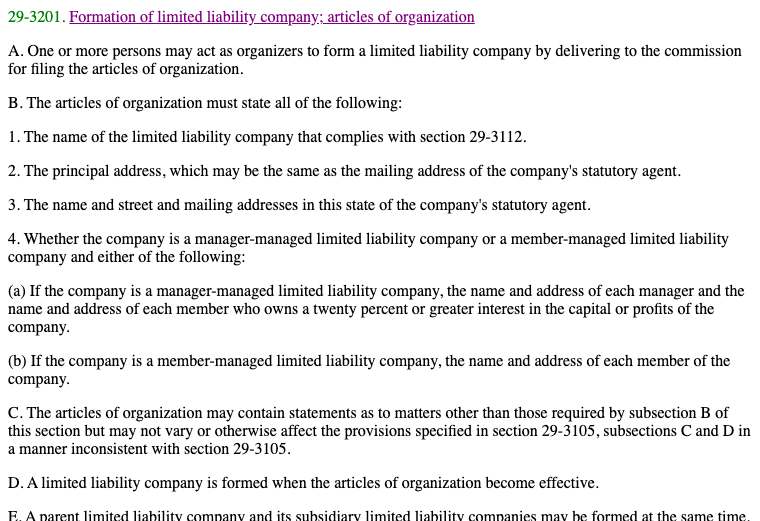
1. Articles of Organization ($50 - Mandatory)
The Commission charges $50 to file the Articles of Organization. You can file online through the new Arizona Business Center portal or by mail. Standard filing takes 14 to 16 business days.
Paying a $35 rush fee on top of the base filing fee brings the total to $85. That cuts the wait to roughly 3 to 5 business days. See how long it takes to form an LLC in Arizona for the full timeline breakdown.
See our guide to starting an LLC in Arizona for the full filing walkthrough. For LLC cost breakdowns in other states, check the national LLC cost guide.
A professional LLC service in Arizona can also handle this filing on your behalf. That's an option if you'd rather not do it yourself.
2. Publication of Notice ($60-$120 - Mandatory Unless Exempt)
Arizona requires new LLCs to publish notice of formation in a newspaper. The notice must run for three consecutive weeks, starting within 60 days of approval. The newspaper sets its own rate. Notice often costs $60 to $120, though some papers charge more.
LLCs whose agent is based in Maricopa or Pima County skip this cost entirely. The Commission publishes the notice in its own database at no charge in those two counties.
3. Name Reservation ($10-$45 - Optional)
Reserving a name before filing is optional in Arizona. It works well for owners who need extra time before filing. Owners who want to lock in a name file the Application to Reserve a Limited Liability Company Name.
The filing costs $10 by mail, or $45 online with faster service built in. It holds the name for 120 days. Most owners skip this step and simply file the Articles once their name is ready.
Ongoing Costs to Maintain Active Status
Once the LLC exists, these are the costs that recur yearly or apply as the company operates. They cover the statutory agent, state taxes and annual filings.
1. Statutory Agent Service ($0-$300 Annually - Optional)
Every Arizona LLC must keep a statutory agent on file to receive legal notices and service of process. Any member can serve as the agent for no extra cost.
Alternatively, the LLC can hire a registered agent service in Arizona for roughly $80 to $300 a year. Hiring a service matters most for owners who travel, work from home or want their address kept off public filings. The agent's address becomes part of the public record either way.
2. Transaction Privilege Tax License ($12 - Mandatory If Selling Taxable Goods or Services)
LLCs that sell goods or certain services in Arizona need a Transaction Privilege Tax license from the Department of Revenue. Owners file for it through the JT-1 application or AZTaxes.gov.
The state charges $12 per business location to apply, and some cities can add their own license fees on top. The license must be renewed yearly by January 1. Arizona charges no state renewal fee, though some cities do. Rates vary by county and business type, so check the applicable rate for the LLC's location before setting prices.
3. State Income Tax (2.5%-4.9% - Mandatory)
Arizona LLCs are pass-through entities by default. This means profits flow to the members' personal returns rather than being taxed at the entity level. Members then pay Arizona's flat 2.5% personal income tax rate on their share [1].
An LLC that elects corporate tax treatment instead pays a 4.9% corporate income tax rate on its income. For most small LLCs, pass-through treatment is simpler and often cheaper. See our guide to filing LLC taxes in Arizona for details.
4. Annual Filing (None - Not Applicable)
Arizona LLCs don't file anything yearly with the Commission. There's no report, no fee and no renewal beyond keeping the agent's information current each year.
Optional Costs Worth Knowing About
These are extra expenses that many owners still budget for, even though Arizona law doesn't require any of them. Costs here depend on your choices rather than any state fee schedule.
1. Operating Agreement ($0-$2,500)
Arizona doesn't require an operating agreement to form an LLC. Most owners write one anyway to set management rules and ownership shares in writing. Free templates cover the basics for a simple, single-member LLC.
Multi-member LLCs with more involved ownership splits often hire an attorney instead. Arizona attorney pricing for a drafted agreement often runs $300 to $800 flat fee. Full-service packages can reach up to $2,500.
2. DBA / Trade Name ($10-$35)
An LLC that wants to operate under a name other than its legal name files a Trade Name Application. It goes to the Arizona Secretary of State instead of the Corporation Commission.
Standard filing costs $10 and takes 2 to 3 weeks. Faster filing adds $25 and cuts the wait to 2 to 3 days. The trade name stays valid for 5 years and renews at the same fee.
3. Certificate of Good Standing ($10-$45)
A Certificate of Good Standing confirms the LLC is current on its state filings. Lenders, banks and out-of-state agencies often request one.
Standard mail handling costs $10 and takes roughly 7 to 10 business days. An instant downloadable copy through the online portal costs $45.
4. Certified Copies ($5 Plus $0.50 Per Additional Page)
A certified copy of the Articles or other filed documents costs $5 plus 50 cents per extra page. Faster handling costs $50 plus 50 cents per extra page. Request either option through a Records Request Form. Banks and lenders sometimes ask for a certified copy alongside the Certificate.
5. Employer Identification Number ($0)
An EIN from the IRS is free to apply for online at IRS.gov [2]. The IRS recommends forming the LLC with the state first. Your LLC needs one to open a bank account, hire staff or file federal returns.
Applying before the state filing is approved can delay it. Companies that charge a fee to obtain an EIN are charging for an unnecessary step. Getting one costs nothing to do directly.
FAQs
Does Arizona Require LLCs to File an Annual Report?
No, Arizona does not require LLCs to file an annual report or pay a related fee. That requirement applies only to Arizona corporations, which file yearly and pay a separate fee to stay in good standing.
Does Arizona Charge LLCs a Franchise Tax?
No, Arizona does not charge LLCs a franchise tax. Profits pass through to the members instead, taxed once at the personal level under the state's flat 2.5% income tax rate.
How Much Does It Cost to Register a Foreign LLC in Arizona?
The cost to register a foreign LLC, meaning one formed in another state, is $150 for the Application for Registration filed with the Arizona Corporation Commission. The filing also requires a Certificate of Existence from the LLC's home state.
How Much Does It Cost to Form an LLC in Arizona in the First Year?
Forming an LLC in Arizona in the first year costs a fixed $50 filing fee, plus variables that differ by county: publication charges unless the statutory agent is in Maricopa or Pima County, local business licensing, a Transaction Privilege Tax license and any optional services.
References:
- https://taxfoundation.org/location/arizona/
- https://www.irs.gov/businesses/small-businesses-self-employed/apply-for-an-employer-identification-number-ein-online